Which AI Questions Should Your Business Show Up For?
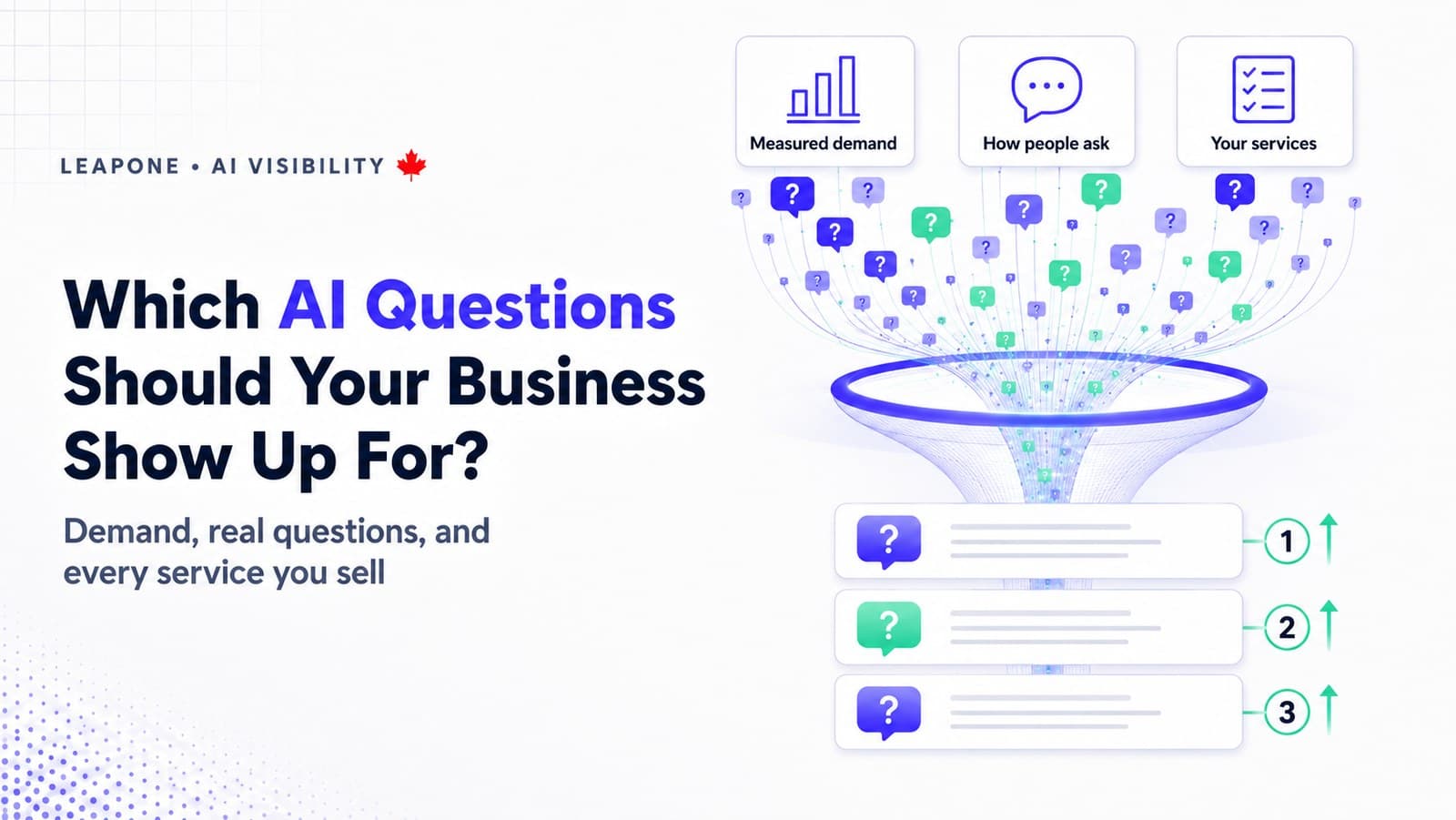
If a tool tells you you're "visible in AI", the first question worth asking is: visible for what? A hundred questions exist for every local business and they are not worth the same. We ran two Canadian studies before deciding how to answer that — 2,030 AI answers across rehabilitation clinics, then 644 clinic recommendations across optometry. This is what they showed, and what we built because of it.
The question behind the question
"Are we showing up in ChatGPT?" sounds like it has one answer. It doesn't.
Being named when someone asks "which dentist can see me tonight for severe tooth pain?" and being named for "teeth whitening" are different businesses' worth of value. One is a patient who books within the hour. The other is browsing.
So an honest answer has to start with which questions were asked, and why those. There are two easy ways to get it wrong.
Track everything. There is no ceiling. You get a big number that averages a real opportunity together with a question nobody has ever asked.
Track whatever's easy to win. This one is more dangerous, because the report looks excellent. Win enough questions nobody asks and you can report high visibility to a business no customer can find.
We measure three things instead. Each one exists because of something the studies showed.
Input 1 — Keywords with real, measured demand
The starting point is what people demonstrably search: monthly search volume, cost-per-click, competition — the commercial signals advertisers bid real money against, pulled per city and per business type. Alongside it we pull AI-specific keyword demand, which estimates how often a term is put to an assistant rather than typed into a search box.
This is the part every tool does, and it matters. A question with thousands of searches behind it is a question worth being in.
But search volume on its own is a poor guide to AI, and the clearest proof is the biggest keyword in the category. Both figures below are Canada-wide, from the demand data behind our optometry study:
"optometrist near me" · Canada · monthly demand
The single largest Google term in the category has no measurable AI demand at all. Nobody says "near me" to an assistant — it already knows where you are. AI figures are modelled estimates, not usage logs.
The biggest search term in the whole category is worth nothing in AI. Rank purely on search volume and that term dominates your report while measuring a behaviour that doesn't happen.
So demand data sets the priorities — it doesn't get to set the whole list.
Input 2 — The way people actually talk to an assistant
Keyword tools were built for search boxes, and people type fragments into search boxes. Nobody talks to an assistant that way. They ask the things they'd ask a receptionist:
"How much does a physiotherapy session cost?"
>
"Which clinic is open on Sunday?"
>
"Does this clinic accept my insurance?"
>
"What's the wait time for an eye exam?"
>
"Which dentist has extended office hours?"
These are the questions that decide whether someone books. Price, hours, insurance, wait time, whether you take children — the practical things, asked in full sentences.
And here is the problem: almost none of them carries any keyword volume at all. Not low volume — none. A keyword tool prices terms; these are sentences, and sentences are not what those tools were built to measure. That isn't a gap that closes as AI grows. It's structural.
So a demand-ranked list, however good the demand data, cannot contain them. They have to be generated deliberately, per business type, and asked alongside the commercial terms.
That's not a small slice of the picture either. When someone asks an assistant "which physiotherapist in Milton takes my insurance and has evening appointments?", that is a customer at the point of booking — far closer to money than a generic category search, and completely invisible to a tool that ranks by search volume.
Input 3 — Every service you sell, including the quiet ones
The third input is the list of services you tell us you offer. Every one gets checked, whether or not anyone can put a number on its demand today.
Two reasons, both from the data.
First: low demand is not low value. An emergency root canal has a fraction of the search volume of teeth whitening and is worth many times more per patient. A rural clinic's specialty may never register measurable volume and still be the most profitable thing it does.
Second, and less obvious: the quiet service terms are the fastest-growing ones. These are the 12-month trends from our Canada-wide AI demand data:
AI demand growth · Canada · 12 months
| Service term | Volume | Trend |
|---|---|---|
| pelvic floor therapy | 148 | +249% |
| cataract surgery | 1,813 | +158% |
| shockwave therapy | 557 | +52% |
| lasik | 2,134 | +34% |
| back pain treatment | 19 | −33% |
Modelled AI demand across Canada, earliest vs latest quarter of the available 12 months. Small numbers, steep slopes — and not all in the same direction.
Pelvic floor therapy sits at 148. A demand-ranked tool drops it. It also grew 249% in a year — which is the point. You track a service because of where it is going, not because of where it is. AI usage is still expanding, and the terms expanding fastest inside it are exactly the specific ones that look too small to bother with today.
Note the last row too. Not everything is rising, and the only way to know which is which is to keep measuring.
Why all three, and not one
The optometry study is what settled the argument. We watched which websites ChatGPT actually used as sources, split by the kind of question asked. It was the single largest difference in the whole study.
How often ChatGPT used the clinic's own website as a source — on the broad question "best optometrist in {city}" versus a specific service such as dry eye treatment or children's myopia control.
Canadian AI Visibility Report 2026, second edition · 8 cities · measured inside ChatGPT only, across its top three recommendations per question.
On the broad category question — the one with all the search volume, the one every tool tracks — a clinic's own website was the source 2.8% of the time. AI answered it out of directories and roundup articles instead. On a specific service question, the clinic's own site was the source 43% of the time.
The question with the most demand is the one you are least likely to be quoted on. The questions where your own content actually gets used are the ones keyword tools cannot price.
That is why one input is never enough:
- Demand only → you optimise for the term you can't win and miss how people actually ask.
- Conversation only → complete coverage of phrasing, no idea which parts are worth money.
- Services only → you measure your whole menu with no sense of priority.
Together they answer three different questions honestly: where is the money, how do people really ask, and is anything I sell invisible.
What we do with the answers
Every question is put to the major AI assistants and checked for whether you were named — repeatedly over time, because the first study found that asking once proves nothing. The same clinic held the top recommendation in as few as 5 of 24 questions depending on the engine, while Google's #1 held in 22 of 24.
What comes back drives two things:
Recommended actions, ranked. A gap on a high-demand question outranks a gap on a quiet one. You work down a list instead of guessing.
Content, aimed. When a question has demand and you're absent, that's the page to write — and we can say what it needs to cover, because we can see what AI quoted instead of you.
The honest limits
- AI demand figures are modelled estimates, not usage logs. Nobody outside the AI companies has the real numbers. Use them to compare and to read direction, never as a literal count.
- Demand is category-wide, not your street. Treat it as weather, not a local forecast.
- Coverage is bounded. We measure a ranked set per market, not every phrasing that exists. Nobody can do the latter — the honest thing is to say which set, and why.
- Both studies are observational. They show what the named businesses had in common, not that those things caused the recommendation.
- The systems change. A question that surfaces you today may not next month. That's the argument for measuring on a schedule rather than once.
What to ask any tool you're considering
Three questions separate a real measurement from a flattering one:
- Which questions did you measure, and can I see them? If they won't show you the list, the number means nothing.
- How were they chosen? "Our AI generated them" is not an answer. Ask what demand data sits behind them.
- Do they include my actual services? A tool that only tracks your category term is tracking the question you're least likely to win.
Run a free AI visibility check on your business — you'll see which questions we measure for your category and city, and which ones name a competitor instead of you.
FAQ
How do you decide which AI questions to track for my business?
Three inputs. Keywords with measured demand — real search volume, cost-per-click and competition pulled per city and business type, plus AI-specific keyword demand. The conversational way people actually address an assistant, which keyword tools structurally cannot see. And every service you tell us you offer, whether or not its demand is measurable today. Each exists because of a finding in our own Canadian studies rather than a guess about how AI works.
What counts as a conversational question, and why do they need separate tracking?
The practical things a customer would ask a receptionist, in full sentences: how much a session costs, which clinic is open Sunday, whether you accept their insurance, what the wait time is, whether you see children. These are the questions that decide whether someone books — and almost none of them carries any keyword volume at all. Not low volume, none. Keyword tools price terms; these are sentences, and sentences aren't what those tools were built to measure. That gap is structural, so it doesn't close as AI grows. A demand-ranked list cannot contain them, which is why they're generated deliberately per business type and asked alongside the commercial terms.
Why track services that have little or no search demand?
Two reasons. Low demand isn't low value — an emergency root canal has a fraction of the search volume of teeth whitening and is worth far more per patient. And the quiet service terms are growing fastest: in our Canada-wide AI demand data, pelvic floor therapy grew 249% in twelve months from a base of 148, cataract surgery 158%, shockwave therapy 52%. A tool that ranks purely on today's volume drops exactly the terms that are about to matter. Not all of them rise, which is the argument for measuring rather than assuming.
Isn't tracking the category term enough?
It's the one you're least likely to win. In our optometry study, ChatGPT used a clinic's own website as a source just 2.8% of the time on "best optometrist in {city}" — it answered from directories and roundups instead — against 43% on a specific service question. Meanwhile "optometrist near me" draws 74,000 monthly Google searches across Canada and has no measurable AI demand at all, because nobody says "near me" to an assistant that already knows where they are.
Does a tool that writes its own questions just inflate its numbers?
It can, and that's the right thing to be suspicious of. If a tool picks easy questions it can report high visibility to a business no customer can find. Two things guard against it: demand ranking, so questions are weighted by evidence people actually search them, and transparency — you can see the exact list measured for your market. Ask any tool for that list. If you can't get it, the score isn't checkable.
How often should AI visibility be measured?
On a schedule, not once. Our optometry study asked the same question three times across two days: the same clinic stayed the top recommendation in as few as 5 of 24 questions depending on the engine, while Google's top result held in 22 of 24. A single check is a snapshot of something that moves. What matters is the rate at which you're named over time, across several engines.
About the author
Marwa Saleh
Marwa Saleh is the founder of LeapOne. After a Master’s thesis on decision support systems and two decades building enterprise systems across airlines, real estate, healthcare and telecom, she built LeapOne to help Canadian small businesses make sense of AI search. Built in Milton, Ontario.