How it works

How LeapOne gets your business recommended by AI

When customers ask ChatGPT, Gemini or Google's AI “who's the best service in my city?”, LeapOne makes sure your name comes up — and keeps it there as AI answers change every month. Here's how each part works.

The monthly loop

AI visibility isn’t one-and-done. LeapOne runs this loop for you every month.

1

Measure

We check how often AI names you across 5 engines.

2

Score

You see your AI Readiness — your foundation.

3

Moves

A short list of the highest-impact actions.

4

Content

We write what gets you cited — ready to publish.

5

Re-measure

Every month, because AI answers keep changing.

Your foundation

What your Score means

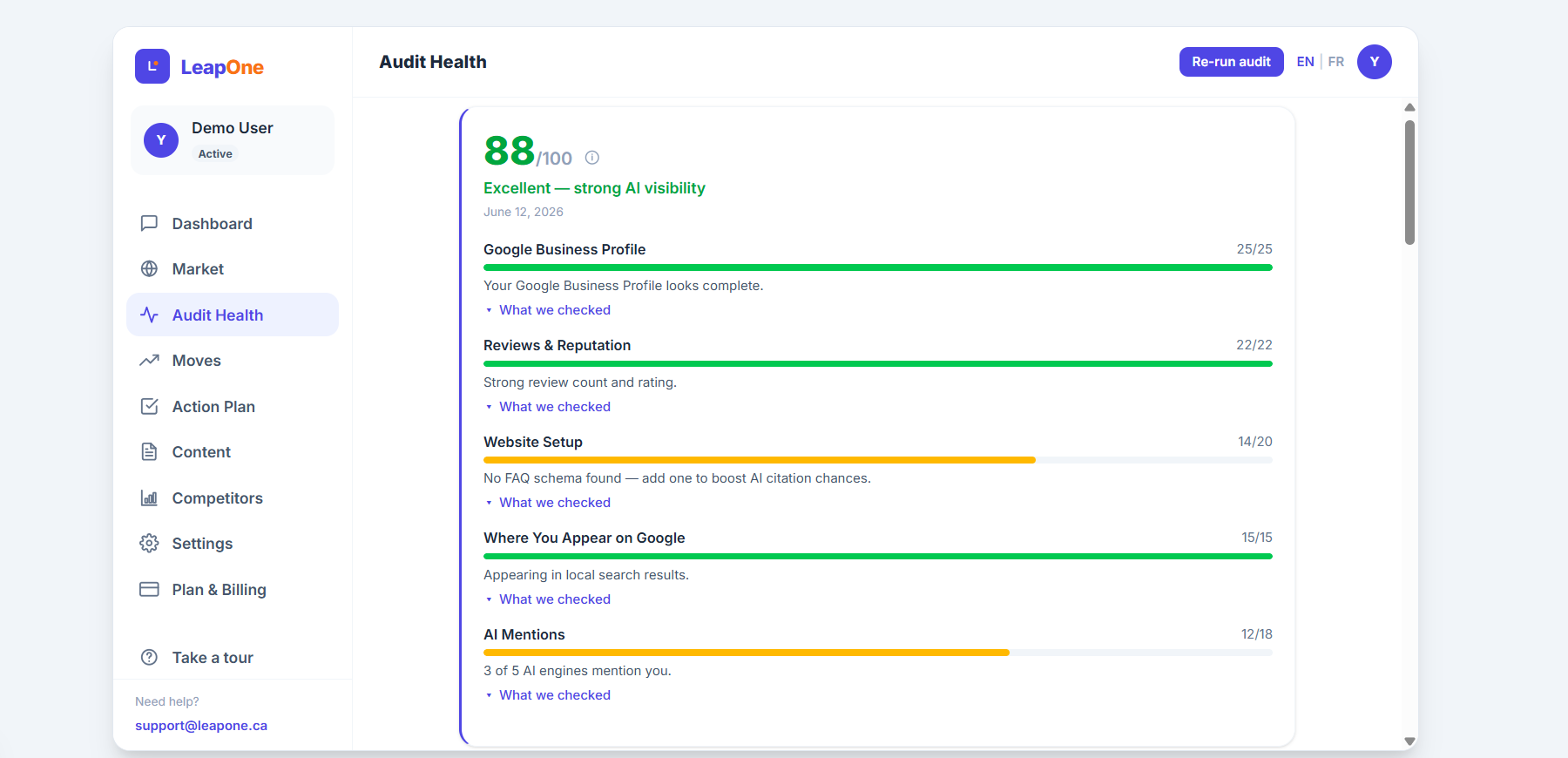
Your AI Readiness Score (out of 100) measures how well your business is set up to be recommended by AI — your Google Business Profile, reviews, website, structured data, and whether AI engines already cite you. A higher score means you’ve done the groundwork that makes AI trust and recommend you.

See exactly how the score is calculated →
Audit Health — your score, broken down by pillar
Two numbers, two questions

Score vs Visibility — why they’re different

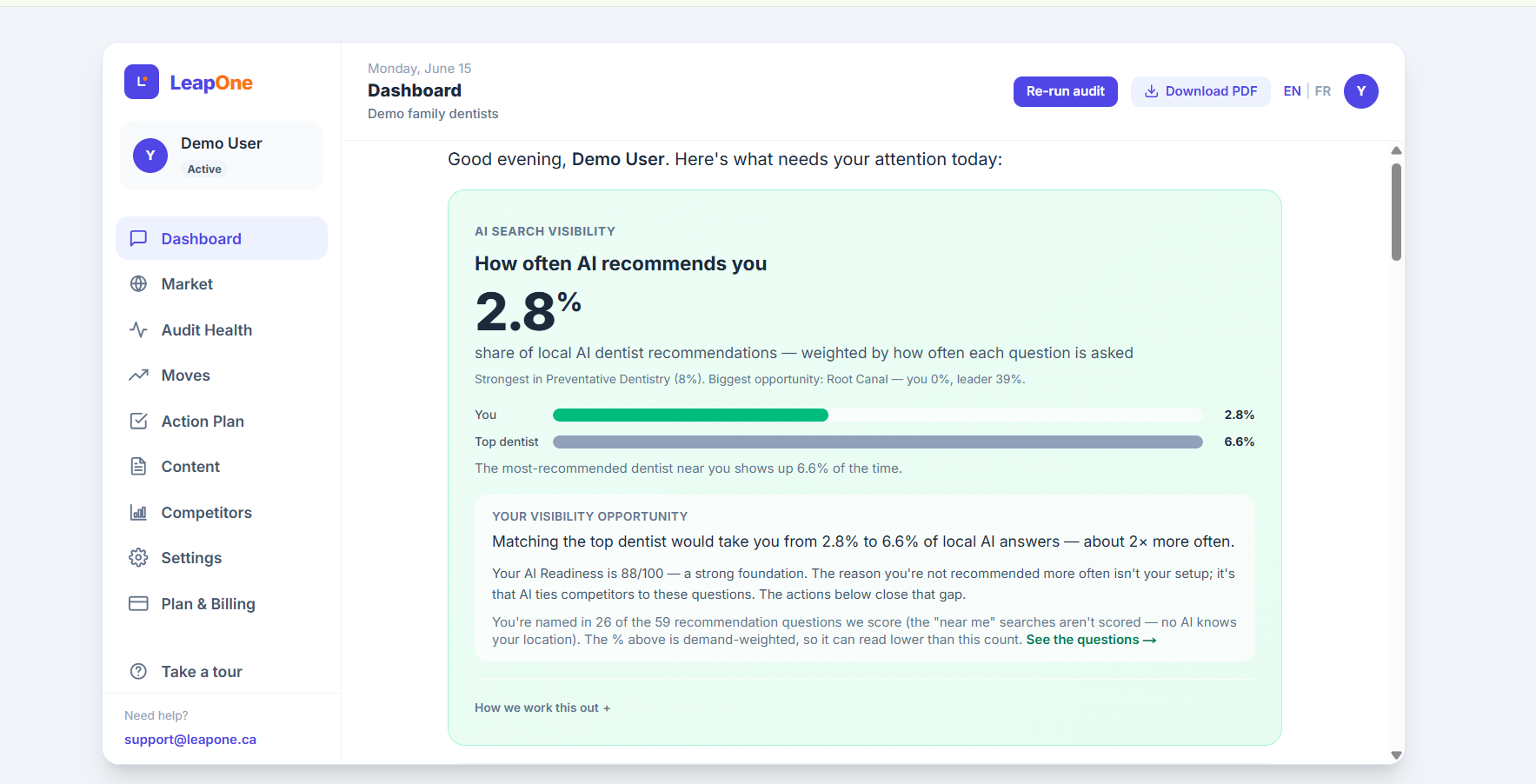
Your Score asks: are you set up right? Your Visibility asks: how often does AI actually name you right now? You can have a strong foundation (high score) and still rarely get named (low visibility) — because competitors are mentioned for the questions customers actually ask. That gap is exactly what your Moves close.

Score = readiness. Visibility = results. We show both, so you always know where the gap is.

Dashboard — your AI Readiness vs how often AI actually names you (and the gap to close)
Across every engine

How each AI engine ranks you

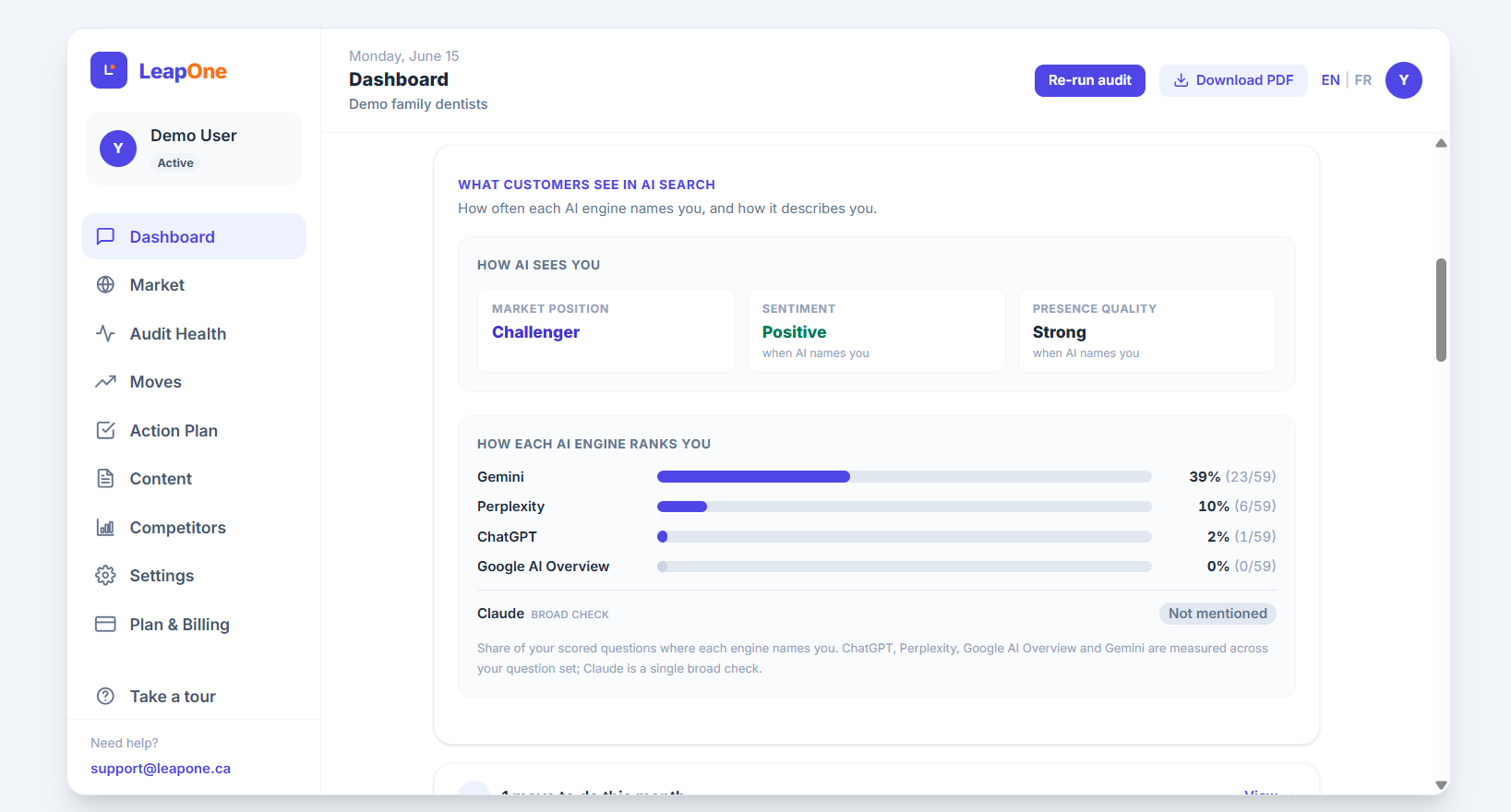
We don’t average the engines — we check each one. See how often ChatGPT, Google AI Overview, Gemini and Perplexity name you across your question set, plus a broad Claude check. And when AI does name you, we show how it positions you, the sentiment, and how strongly — so you know not just whether you appear, but how you come across.

Dashboard — per-engine mention rates + how AI sees you (position, sentiment, presence)
Scorecard vs playing field

Dashboard questions vs Market questions

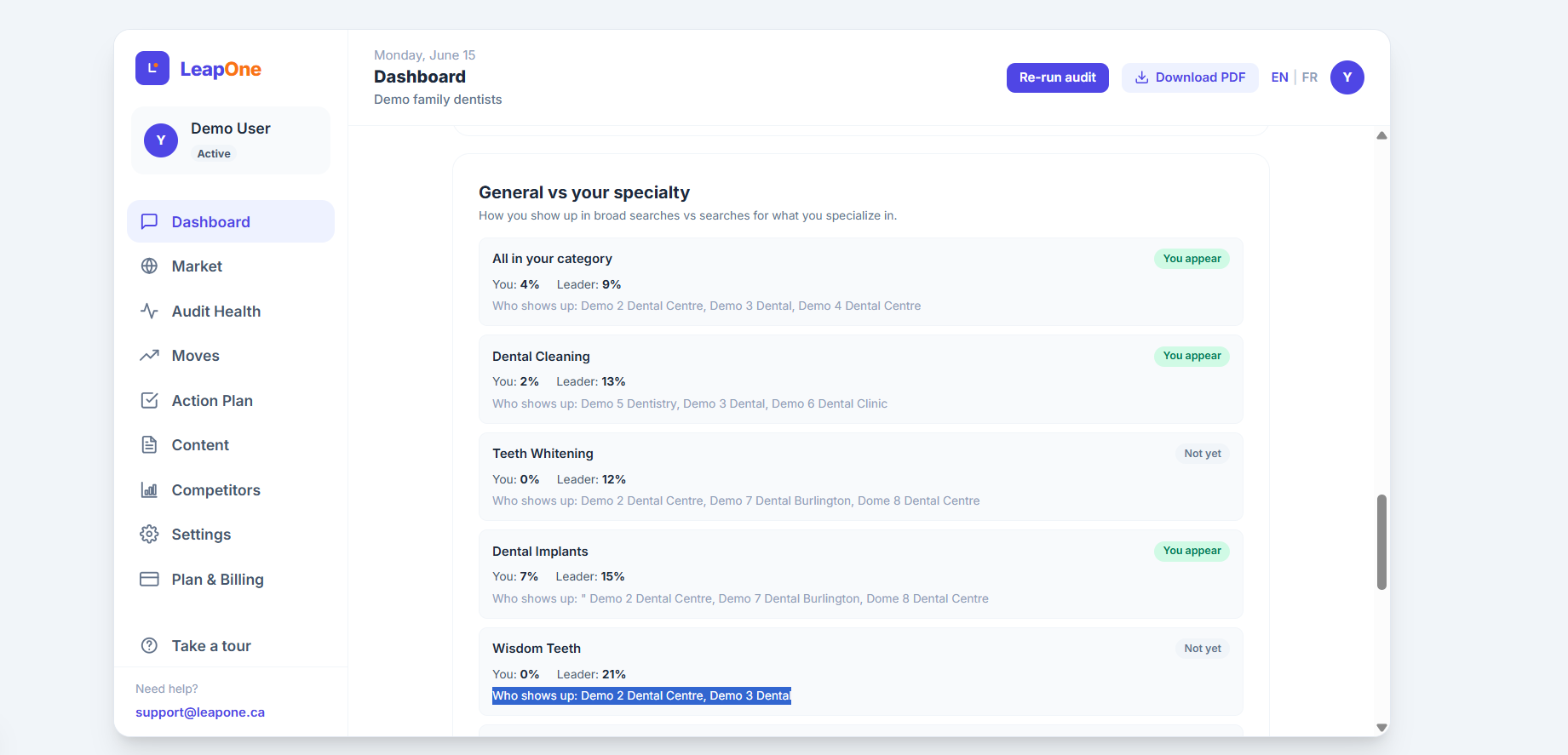
Same world, two different jobs — this is the distinction people find most confusing, so here it is plainly. Your Dashboard questions are about YOU; the Market questions are about the whole field you compete in.

  • ·Dashboard questions = your scorecard. A focused, curated set of high-value questions for your category and your specific services. It measures whether AI names YOU on each one — across all five engines — and how you stack up against the market leader. Answers: “How am I doing?”
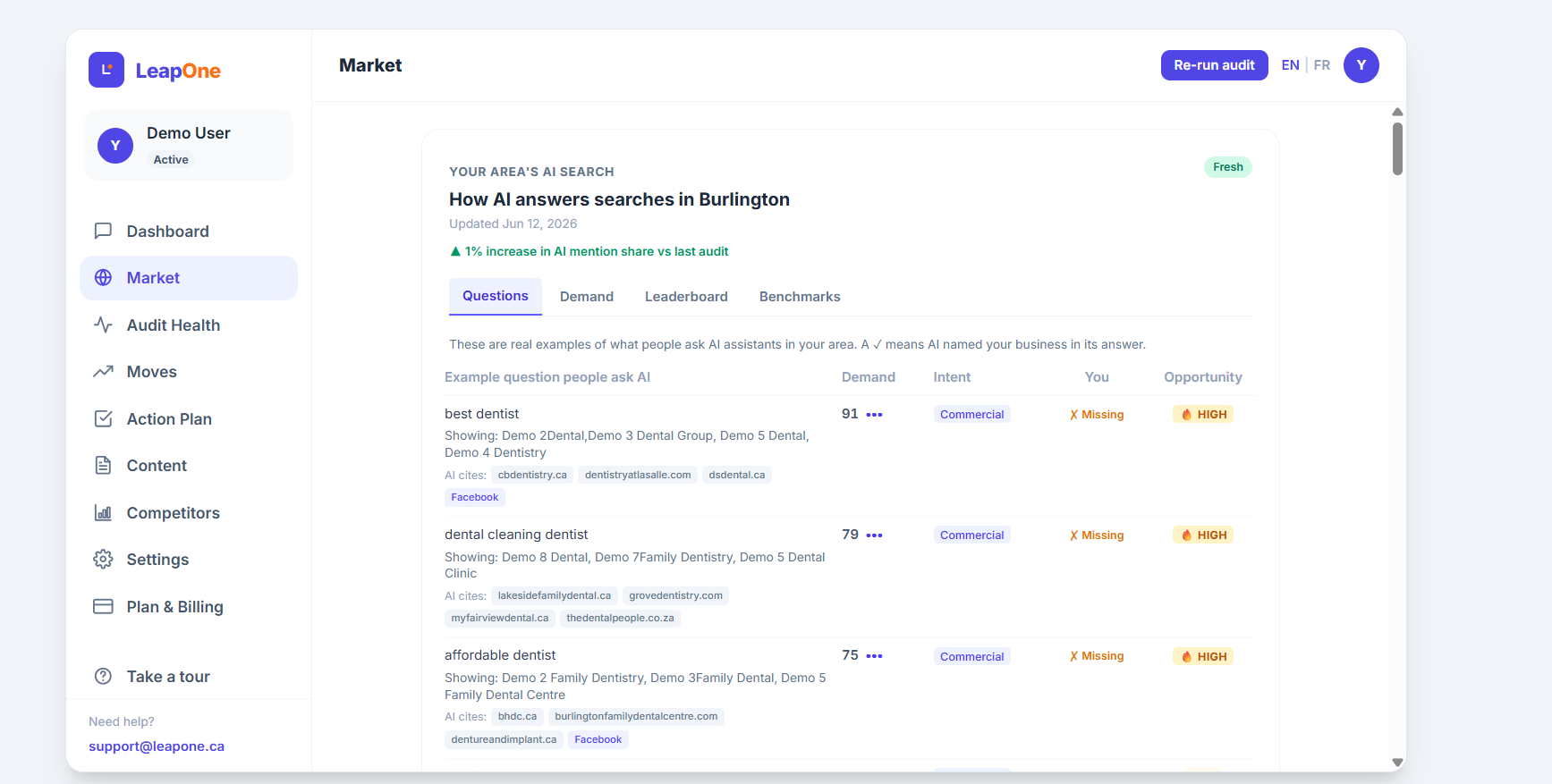
  • ·Market questions = the playing field. The full list of questions real customers in your city actually ask AI — a much larger pool, including ones you don’t appear in yet. It measures the demand behind each question (how often it’s asked) and which business AI recommends for it — the leaderboard, not just you. Answers: “Where’s the opportunity, and who’s winning it?”
  • ·How they connect: the gaps the Market view exposes — high-demand questions where AI names a competitor instead of you — are exactly what your Moves and Content are built to close.
Dashboard — how you show up on each question (you vs the leader, and who’s named)
Market tab — every question, the demand, and who AI names
Your local AI landscape

Inside the Market tab

Beyond the Questions view above, the Market tab gives you three more lenses on AI search in your area — so you know not just where you stand, but where the demand and the competition are:

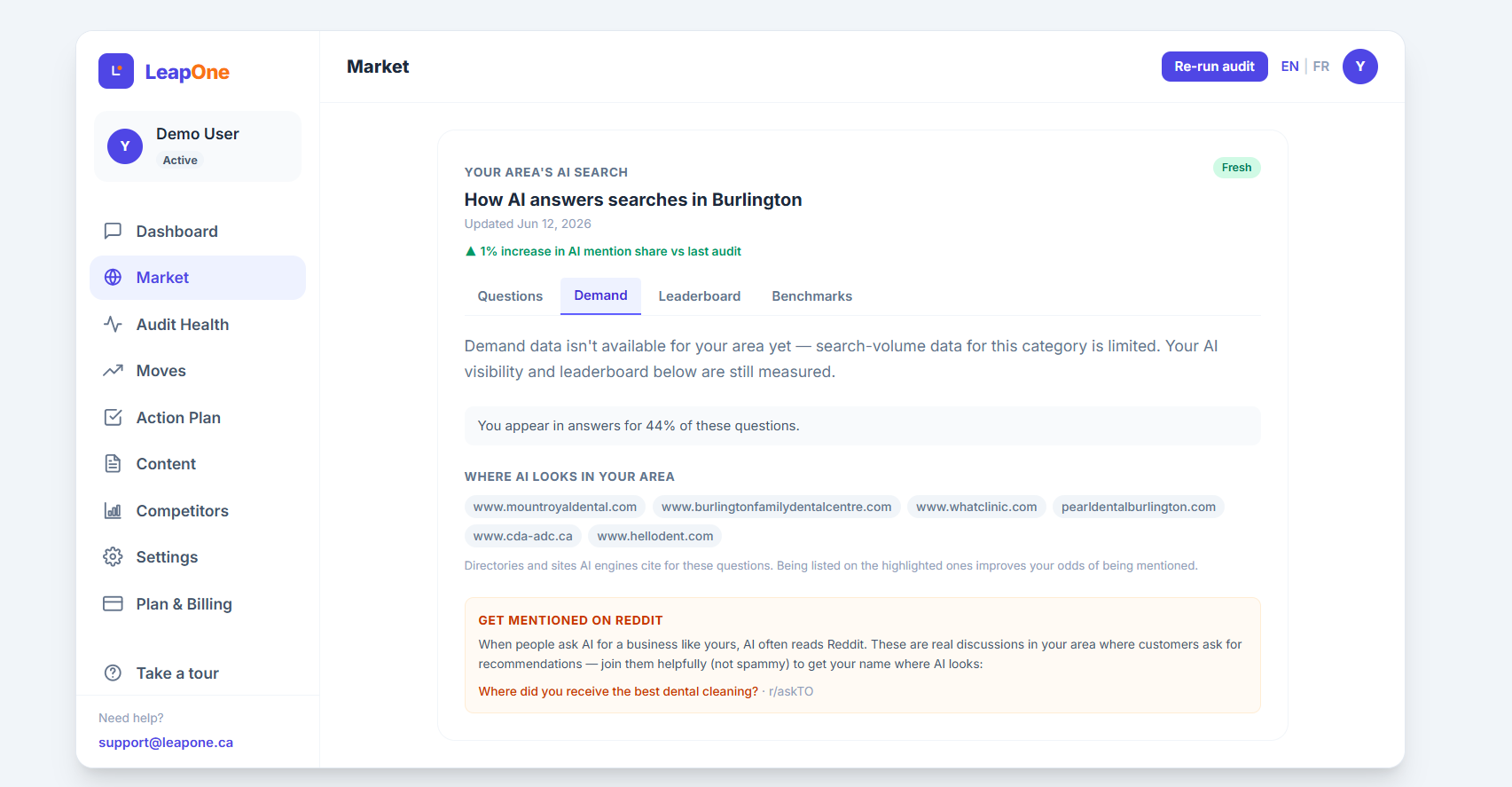
  • ·Demand — how much each question is searched, the directories AI cites, and real Reddit threads to join.
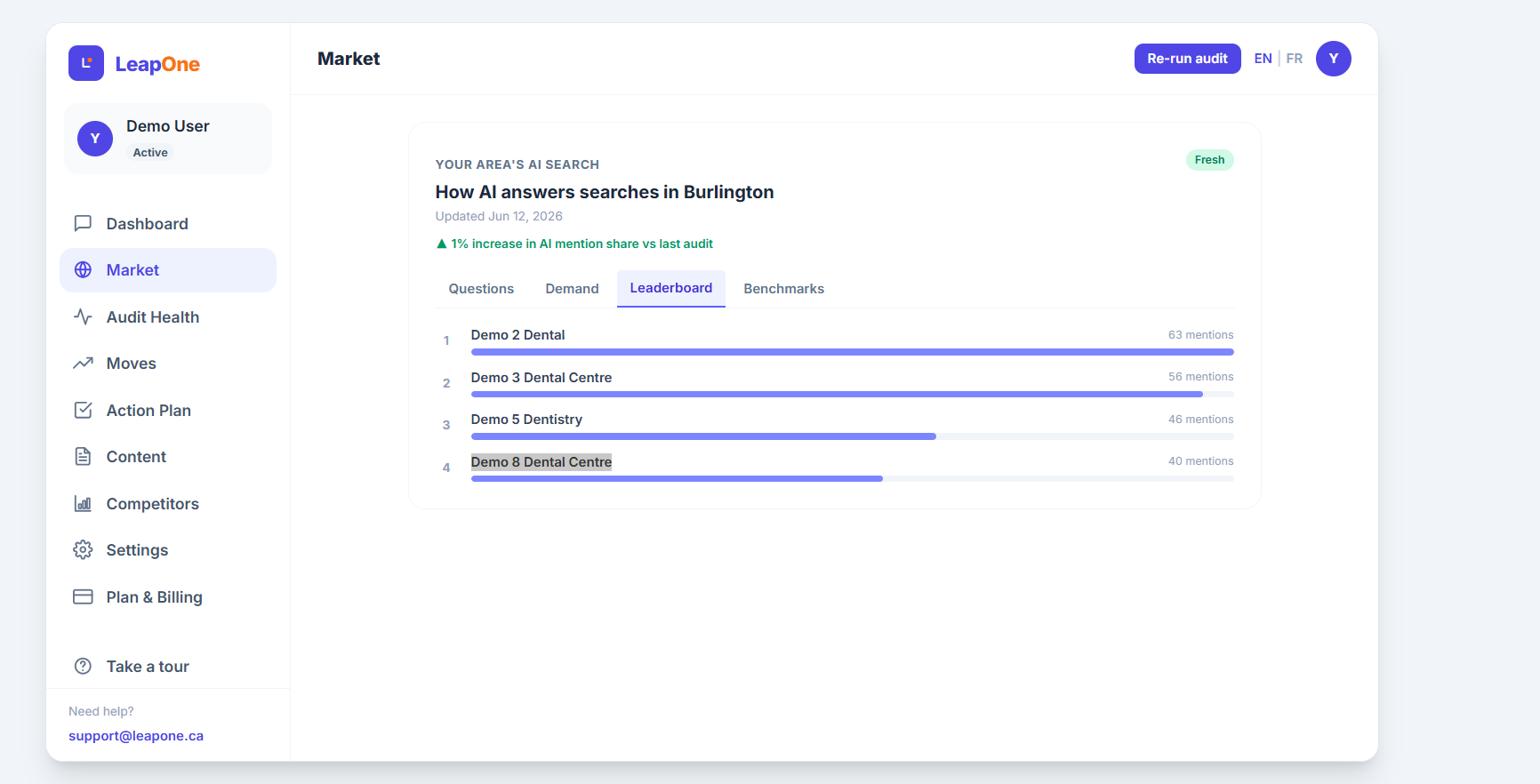
  • ·Leaderboard — which businesses AI names most often in your area.
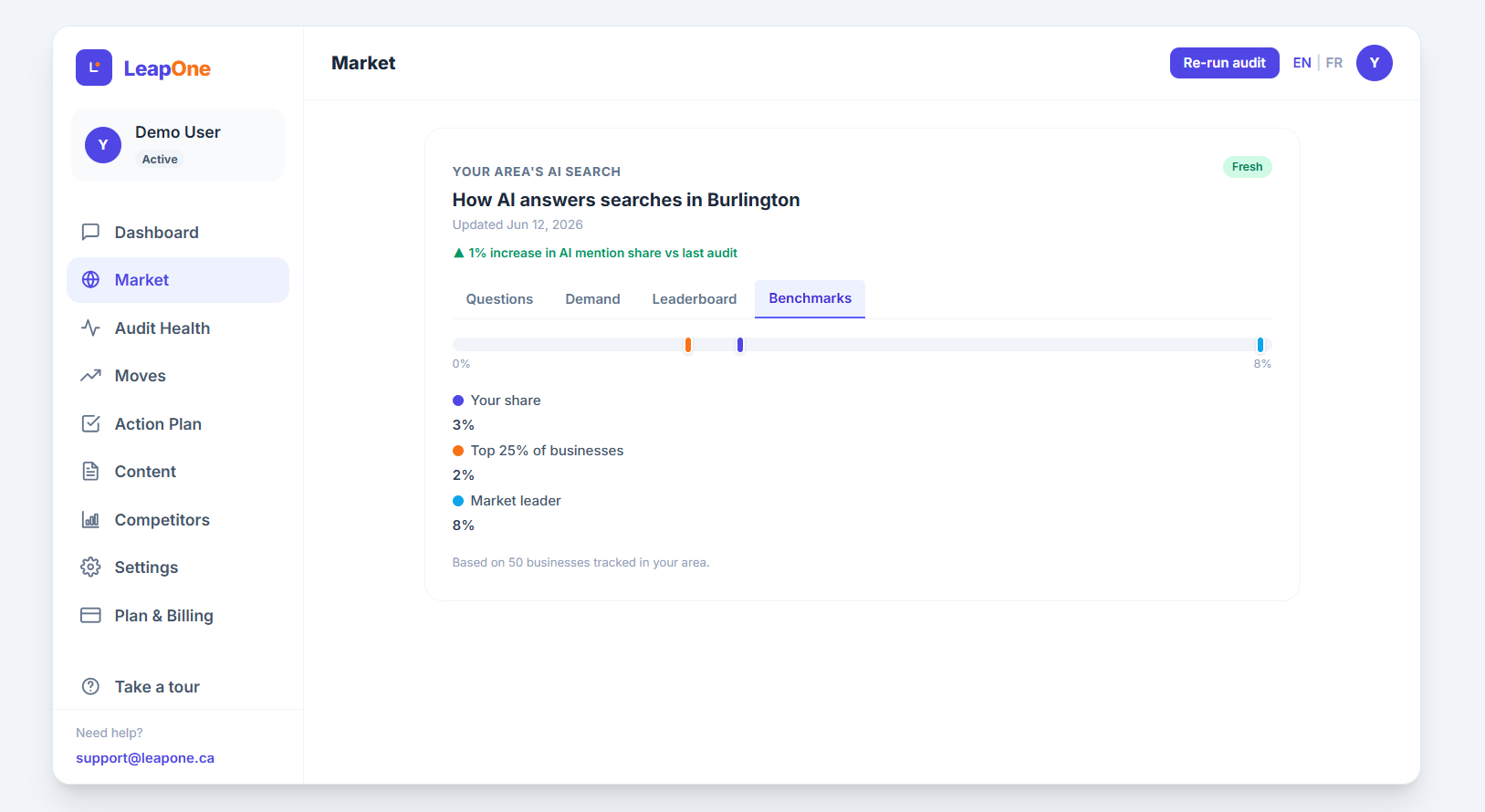
  • ·Benchmarks — your share of AI answers vs the top 25% of businesses and the market leader.
Demand — search volume, the sites AI cites, and Reddit threads where customers ask
Leaderboard — who AI recommends most in your area
Benchmarks — your share vs the top 25% and the market leader
Your next steps

Moves — what to do this month

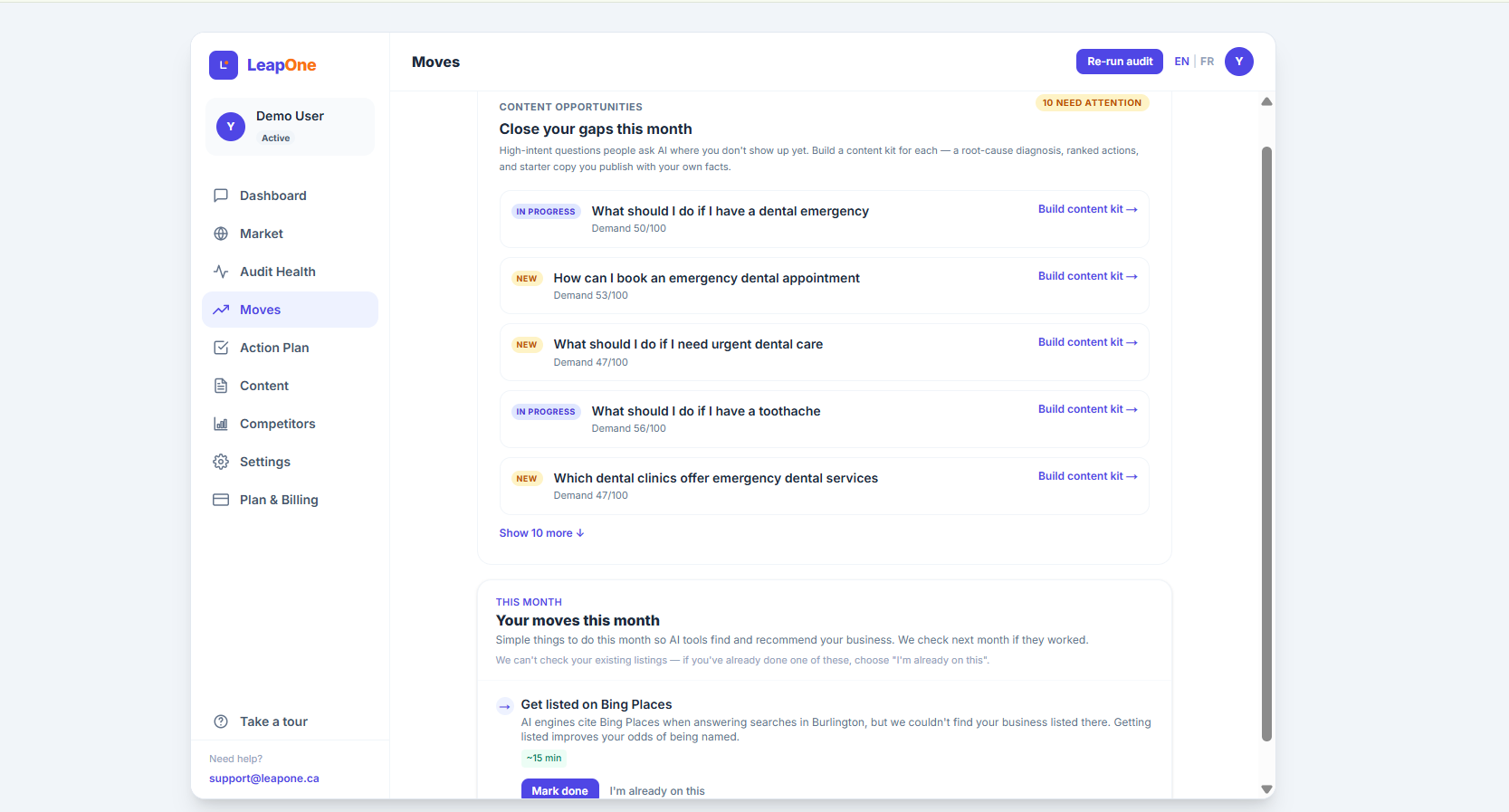
Moves are your short, prioritized to-do list to get named more often — the few highest-impact actions, not a 50-item audit. Some are quick fixes (get listed where AI looks); others are content gaps to close. Because AI answers shift monthly, your Moves refresh every month so you’re always working on what matters now.

Moves — close-your-gaps content opportunities + this month’s quick wins
Done, not just advised

Content — we write what gets you cited

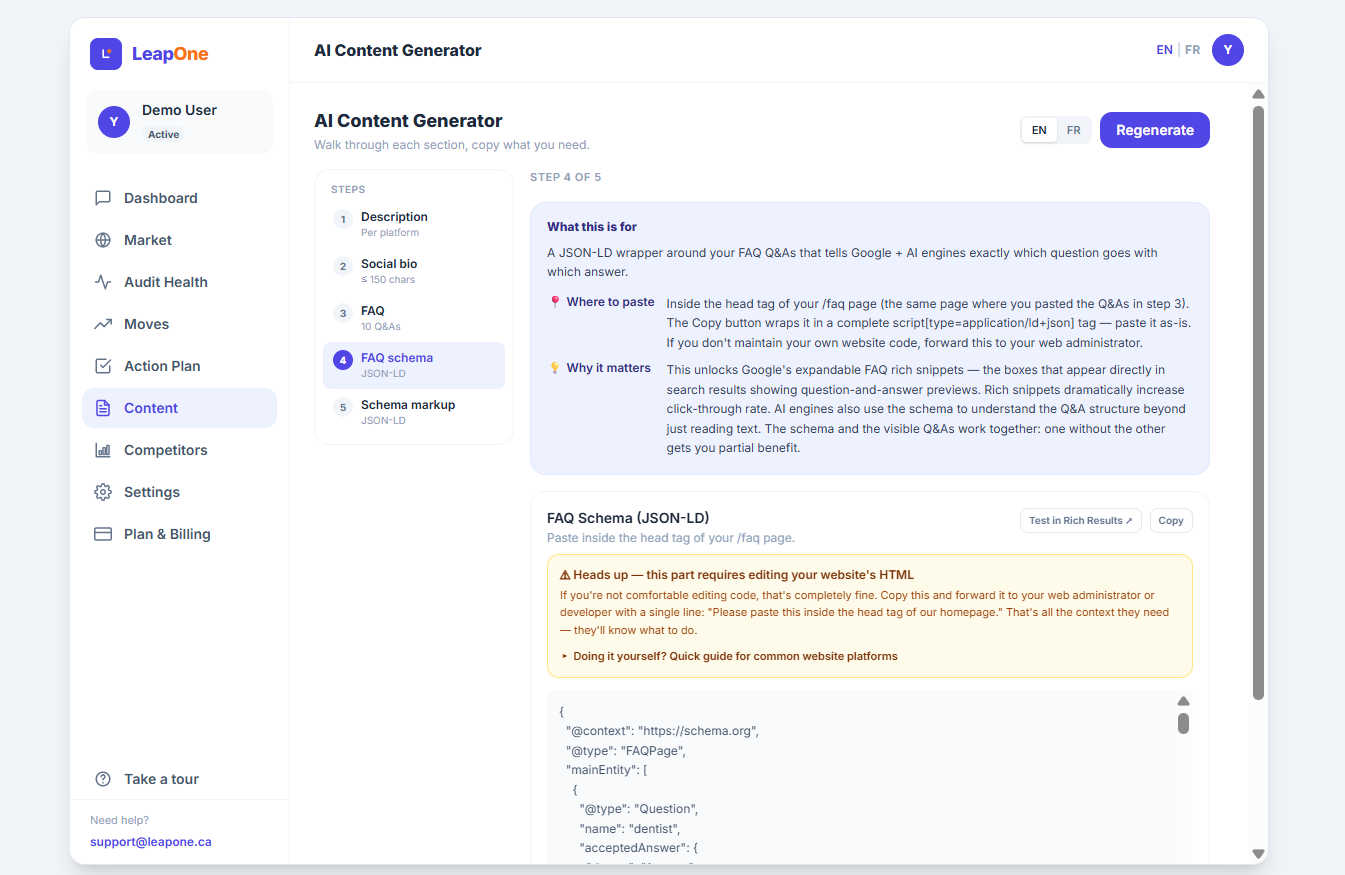
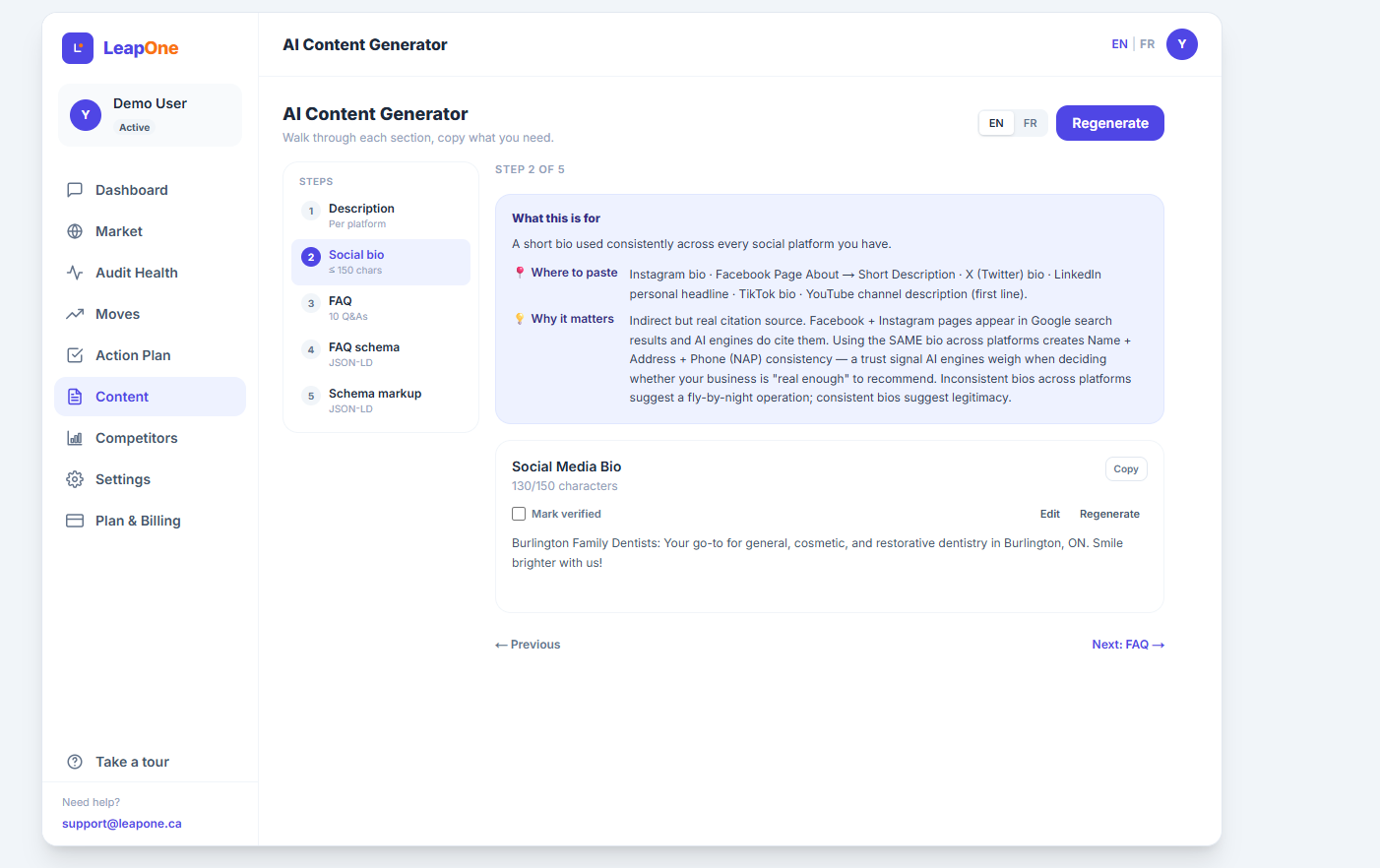
Most tools tell you to "write more content." LeapOne walks you through a guided generator that writes each piece for you — grounded in your real business, copy-ready, in English or French. For every section it tells you what it’s for, where to paste it, and why it matters for AI. The five sections:

  • ·Business description — for your website and listings.
  • ·Social bio — one consistent bio across every platform (a trust signal AI weighs).
  • ·FAQ — the 10 questions customers actually ask, answered.
  • ·FAQ schema (JSON-LD) — the structured data AI reads, generated for you.
  • ·LocalBusiness schema (JSON-LD) — tells AI exactly who and where you are.

No writing, no code. Copy each piece in one click — or send the FAQ straight to your action plan.
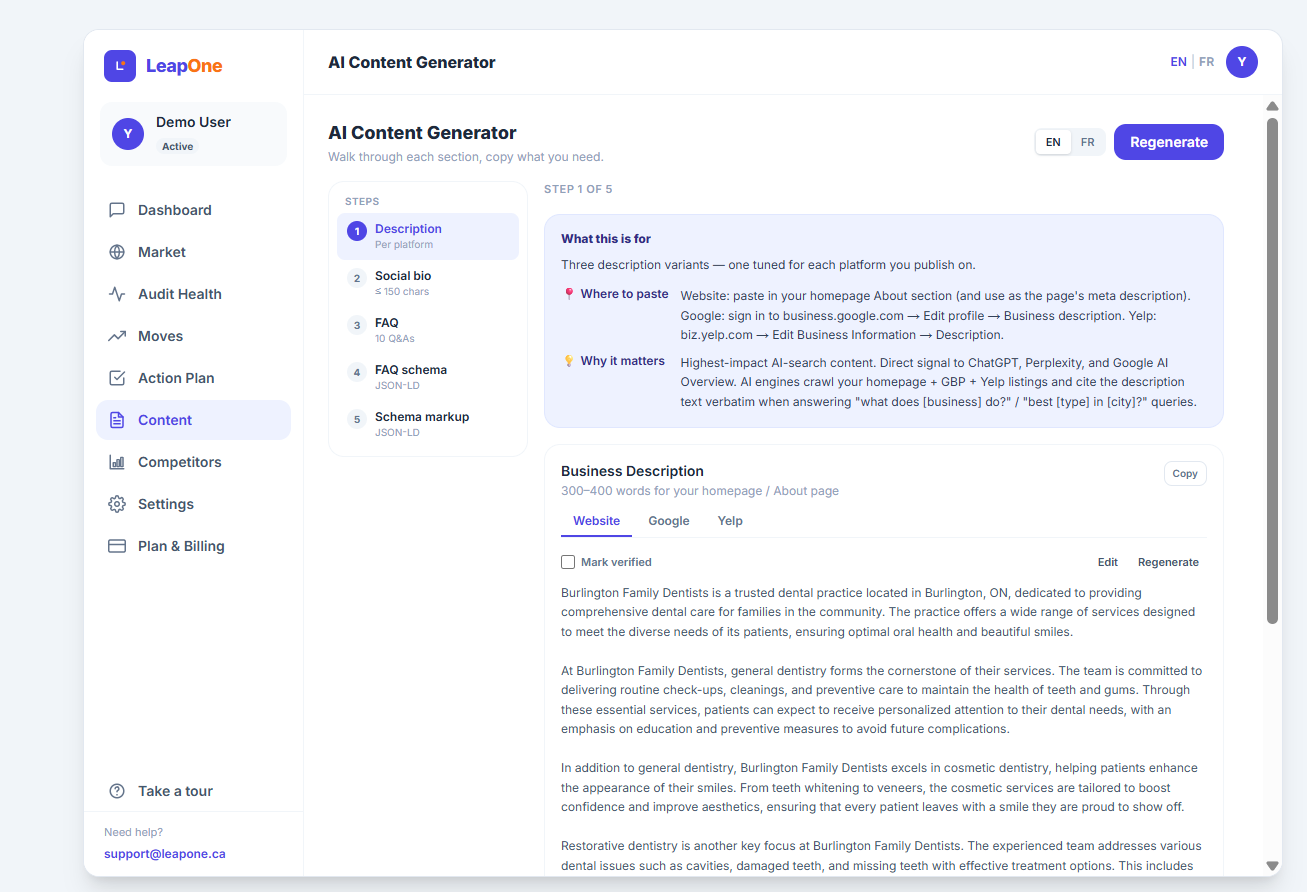
Start from a question you’re losing — the generator is grounded in your business
Every section explains what it’s for, where to paste it, and why it matters
It even outputs the FAQ & LocalBusiness schema (JSON-LD) AI reads — no code skills needed

Common questions

How do I get my business recommended by ChatGPT or Gemini?

Be set up so AI trusts you (your Score), then close the gaps where competitors get named instead (your Moves and Content). LeapOne measures both across five AI engines and tells you exactly what to do.

Is AI search really replacing Google for local businesses?

Increasingly, yes. Customers ask AI assistants for a recommendation and act on the answer without ever visiting a results page. If AI doesn’t name you, you’re invisible to them.

Why does my visibility change month to month?

AI answers are regenerated constantly and your competitors keep improving. A one-time fix decays — which is why LeapOne re-measures every month and gives you fresh Moves.

Which AI engines does LeapOne check?

Five: ChatGPT, Google AI Overview, Gemini, Perplexity and Claude — automatically, every month.

Do I need technical skills?

No. We hand you plain-English Moves and ready-to-publish content — including the schema code, generated for you. No code, no jargon.

See where your business stands in AI search

Run your first audit free — find out whether AI recommends you today, and exactly what to do next.

Start free →

LeapOne · Get found in AI search