Top on Google. Not Automatically Top in AI.
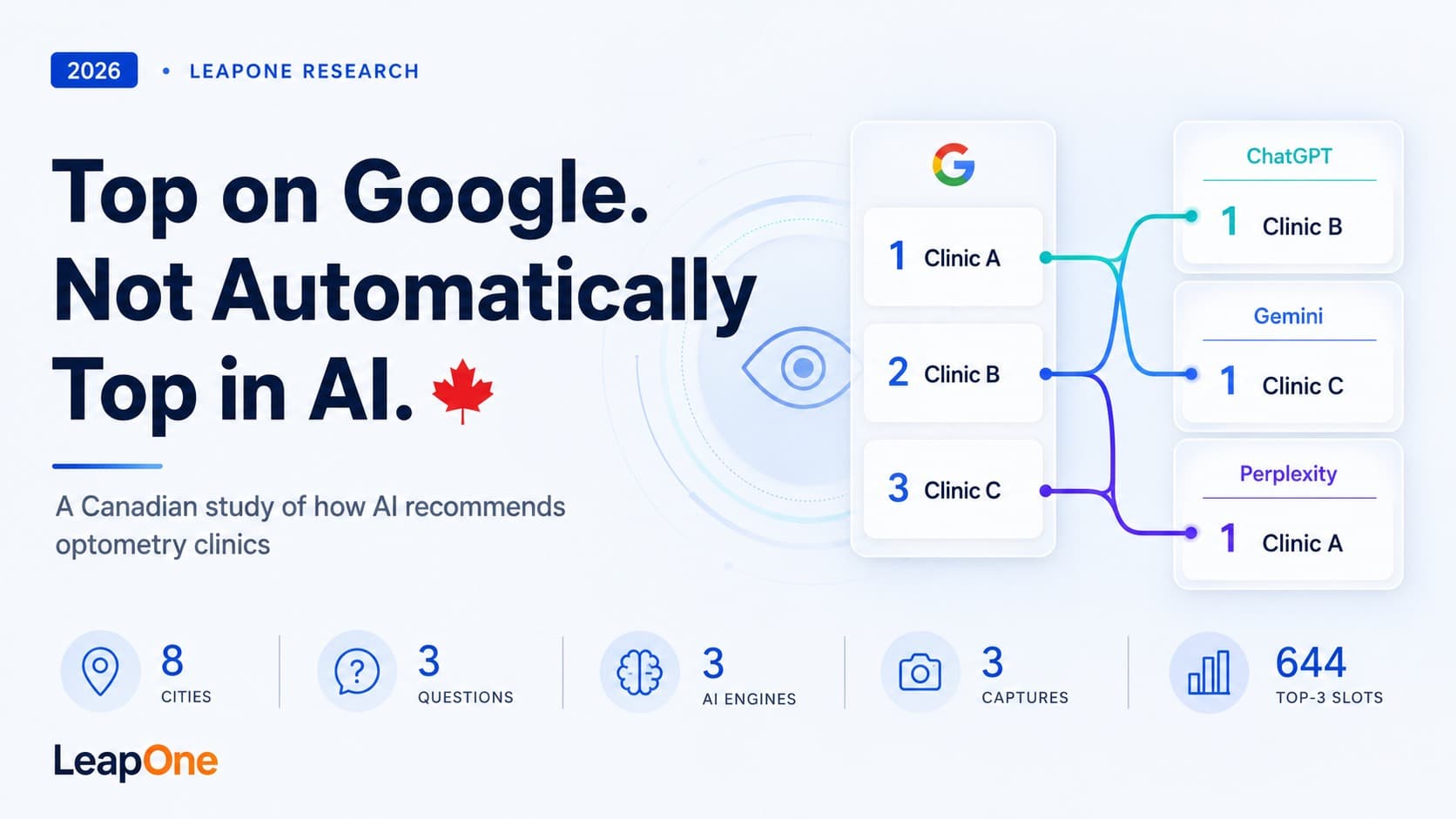
The 2026 Canadian AI Visibility Report — second edition. A LeapOne study of how ChatGPT, Gemini and Perplexity recommend Canadian optometry clinics, across 8 cities and 3 kinds of patient question. We asked every question three times. The first edition measured rehabilitation clinics across 2,030 AI answers, and found that two in three were never named at all.
Key finding
Being top on Google does not make you top in AI. Ask the same question three times and the leading AI recommendation usually changes — while Google's barely moves.
Questions where the same clinic stayed #1 across all three rounds · 24 questions per engine · 8 Canadian cities · July 2026
Canadian AI Visibility Report 2026 · LeapOne Research · leapone.ca
Key findings (Canada, July 2026)
- There is no ranking to hold. The same clinic stayed the top recommendation in only 5–7 of 24 questions, depending on the engine. Google's search results held their #1 in 22 of the same 24.
- Your map ranking doesn't transfer. Of the clinics AI named, only about 1 in 7 was also in Google's top three map results — but about 1 in 5 was in Google's top three search results.
- You get quoted for services, not for "best optometrist." ChatGPT used a clinic's own website as a source for 43% of the clinics it named on a service question, and just 2.8% on the general one.
- Reviews separated the named from the unnamed — a median of 177 Google reviews versus 96. Star rating showed no difference at all.
- ChatGPT, Gemini and Perplexity barely agree with each other. Each agreed with itself across rounds about two and a half times more than it agreed with a different engine asked the same question on the same day.
Why eye care, and why now
Before this study we measured demand for each kind of local business on AI and compared it against Google search over the same year. Of the six categories we could measure on both, only two are rising on both — and eye care's growth on AI is four times the other's. In the remaining four, AI climbed while Google slipped.
AI engines · Canada
▲ 21.1% over 12 months
estimated monthly demand across eye-care service terms
Google search · Canada
▲ 7.8% over 12 months
monthly searches across the same terms
How to read these two numbers. The AI figure is a modelled estimate, not usage logs — nobody outside the AI companies has the real logs. Use it to compare categories and read direction, never as a literal count of what anyone typed. Both figures are Canada-wide across the same ten eye-care terms, and each trend is measured against its own twelve months earlier. They are not a like-for-like scale — a modelled AI estimate and Google's reported volume are different instruments, so read the two directions rather than the ratio between the totals. Both are also across all phrasings, not your city — AI keyword tools score a local question like "optometrist in Toronto" at a small fraction of what Google shows for the same words. Treat this as category weather, not your local forecast.
The point isn't the size. It's that patients aren't moving from one place to another — for eye care, AI is a second place they now look, on top of the one you already compete in.
The thing your patients use has no page two
A patient with three weeks of dry eye doesn't scroll. They ask an assistant "who should I see in Burlington?" and they trust the three or four names that come back.
Which raises the obvious question for anyone running a clinic: how do you get into that list? The usual answer — rank well on Google — turns out to be only a third right. So we measured it.
Finding 1 — Your map ranking doesn't transfer. Your website partly does.
When each engine named its top three clinics, we checked how often those same clinics appeared in Google's top three: first the ordinary search results, then the map pack.
Also in Google's top 3 search results
Also in Google's top 3 map results
Bars scaled to 30%. Equal depth on both sides — each engine's top 3 against Google's top 3 for the same city, the same question, the same moment.
All three engines landed within about a point of each other on the search measure. Every one of them scored lower on the map measure.
What this means for you. If your marketing has been about winning the map pack, that work is not reaching AI — being #1 in the local map results is close to no help here. The clinics they named were far more likely to have a website that ranks. So the budget goes into real pages on your own domain, not another round of listing tweaks.
Finding 2 — Nobody can sell you a "#1 ranking in ChatGPT"
That's the key finding at the top of this post, and it's worth being blunt about what it means commercially. There is no ranking to hold. Ask twice and the answer changes.
The three engines also barely agree with each other, which means "am I visible in AI?" has no single answer — it has three, and they disagree.
What this means for you. The goal isn't a position, it's a rate: being named often, across several AI engines and several ways a patient might ask. That's measured by checking repeatedly over time, not once.
Finding 3 — You get quoted for services, almost never for "best optometrist"
We watched which websites ChatGPT actually used as its sources. The gap between a general question and a specific service question was the single largest difference in the whole study.
How often ChatGPT used the clinic's own website as a source — for "best optometrist in {city}" versus a specific service such as dry eye treatment or children's myopia control.
Measured inside ChatGPT only, across its top three recommendations per question. Each engine reports its sources differently, so the three are not comparable on this one measure.
What this means for you. On broad questions AI leans on directories and roundup articles — your homepage barely features, and rewriting it won't change that. Pick the three or four services you actually want more of and give each one a real page that answers what a patient would ask. Those are the pages that got quoted.
Finding 4 — Review count separated the named from the unnamed
We compared every clinic AI named against every other optometry practice in the same cities — 1,012 practices in total.
median Google reviews — clinics that were named
median Google reviews — clinics that were not
Roughly 1.8× as many reviews. Star rating, on the other hand, showed no difference at all — a 4.9 did not beat a 4.6.
What this means for you. Ask every satisfied patient for a review, steadily, forever. It's the cheapest lever in this study and the only one that showed up without any technical work. And stop guarding a perfect average — volume tracked with getting named; the decimal place didn't.
How we did this
We wrote three questions a patient might realistically ask: one general — who is the best optometrist in this city — and two about specific services, dry eye treatment and myopia control in children. We asked all three in eight cities: Milton, Mississauga, Toronto, Ottawa, Vancouver, Calgary, Montréal and Winnipeg. The same questions went to ChatGPT, Gemini and Perplexity, and we captured Google's map results and search results for the same question at the same time.
Then we repeated the whole thing twice more across two days, so that no single answer could stand in for a pattern. The figures above combine all three rounds — 644 individual clinic recommendations in total. Where a figure is limited to an engine's top three picks, it says so. Every clinic was matched to its actual Google Business listing rather than to a name or a domain, so two branches of the same chain are never counted as one practice.
What this study does not tell you
- It shows what the named clinics had in common. It does not prove those things caused the recommendation — a clinic with more reviews usually differs in other ways too.
- It covers optometry in eight Canadian cities. Other fields and other countries may behave differently.
- It covers three tools. There are others, and they may not follow the same pattern.
- Everything here reflects a two-day window. These systems change.
Where to start
If you take one thing from this: the map pack is not the door into AI recommendations, and there is no position to win. What moved with getting named was a website that ranks, a real page per service, and a steady flow of reviews.
Those are all things you already know how to do. The difference is knowing they're the ones that count — and being able to see whether they're working.
Run a free AI visibility check on your clinic — you'll see which AI engines mention you, which name a competitor instead, and which of the four things above you're missing.
If you'd rather compare the software before committing to anything, we've published an honest comparison of the AI search optimization tools — competitors included, and where they're stronger than us.
FAQ
How do I get my optometry clinic recommended by ChatGPT?
Three things separated the clinics that were named from the ones that weren't. A website that ranks in Google's ordinary search results — the clinics AI named appeared there far more often than they appeared in the map pack. A real page for each service you want patients for: ChatGPT used a clinic's own website as a source 43% of the time on a specific service question like dry eye treatment, against 2.8% on "best optometrist in {city}". And review volume: named clinics had a median of 177 Google reviews versus 96 for the rest. Note that this study shows what the named clinics had in common, not that those things caused the recommendation.
Does ranking #1 on Google mean AI will recommend my clinic?
No. When we checked how often each engine's top three clinics also appeared in Google's top three, the overlap was about 22% for search results (ChatGPT 22.9%, Gemini 21.5%, Perplexity 22.2%) and lower again for the map pack (13.6%–17.6%). Being #1 in the local map results is close to no help. Ranking in Google's ordinary search results transfers partly; map ranking barely transfers at all.
Can I get a #1 ranking in ChatGPT?
There is no position to hold. Asked the same question three times, the same clinic stayed top in only 7 of 24 questions on ChatGPT, 6 of 24 on Gemini and 5 of 24 on Perplexity — while Google's top result held in 22 of 24. The three engines also barely agree with each other, so "am I visible in AI?" has three answers, not one. Anyone selling you a guaranteed AI ranking is selling something that doesn't exist. The goal is a rate — being named often, across several engines and several ways a patient might ask — which only shows up if you measure repeatedly over time.
Do Google reviews affect whether AI recommends my clinic?
Review count tracked with being named. Comparing every clinic AI named against every other optometry practice in the same cities — 1,012 practices in total — the named clinics had a median of 177 Google reviews and the unnamed ones 96, roughly 1.8×. Star rating showed no difference at all; a 4.9 did not beat a 4.6. So ask every satisfied patient for a review steadily, and stop guarding a perfect average.
How was this study done?
We asked three questions a patient might realistically ask — who is the best optometrist in this city, plus dry eye treatment and children's myopia control — in eight cities: Milton, Mississauga, Toronto, Ottawa, Vancouver, Calgary, Montréal and Winnipeg. The same questions went to ChatGPT, Gemini and Perplexity, with Google's search and map results captured at the same moment. We repeated everything twice more across two days, giving 644 individual clinic recommendations. Every clinic was matched to its actual Google Business listing rather than by name or domain, so two branches of one chain are never counted as a single practice. Everything here reflects a two-day window in July 2026, and these systems change.
About the author
Marwa Saleh
Marwa Saleh is the founder of LeapOne. After a Master’s thesis on decision support systems and two decades building enterprise systems across airlines, real estate, healthcare and telecom, she built LeapOne to help Canadian small businesses make sense of AI search. Built in Milton, Ontario.