We Asked AI to Recommend a Clinic 2,030 Times. 2 in 3 Clinics Never Came Up.
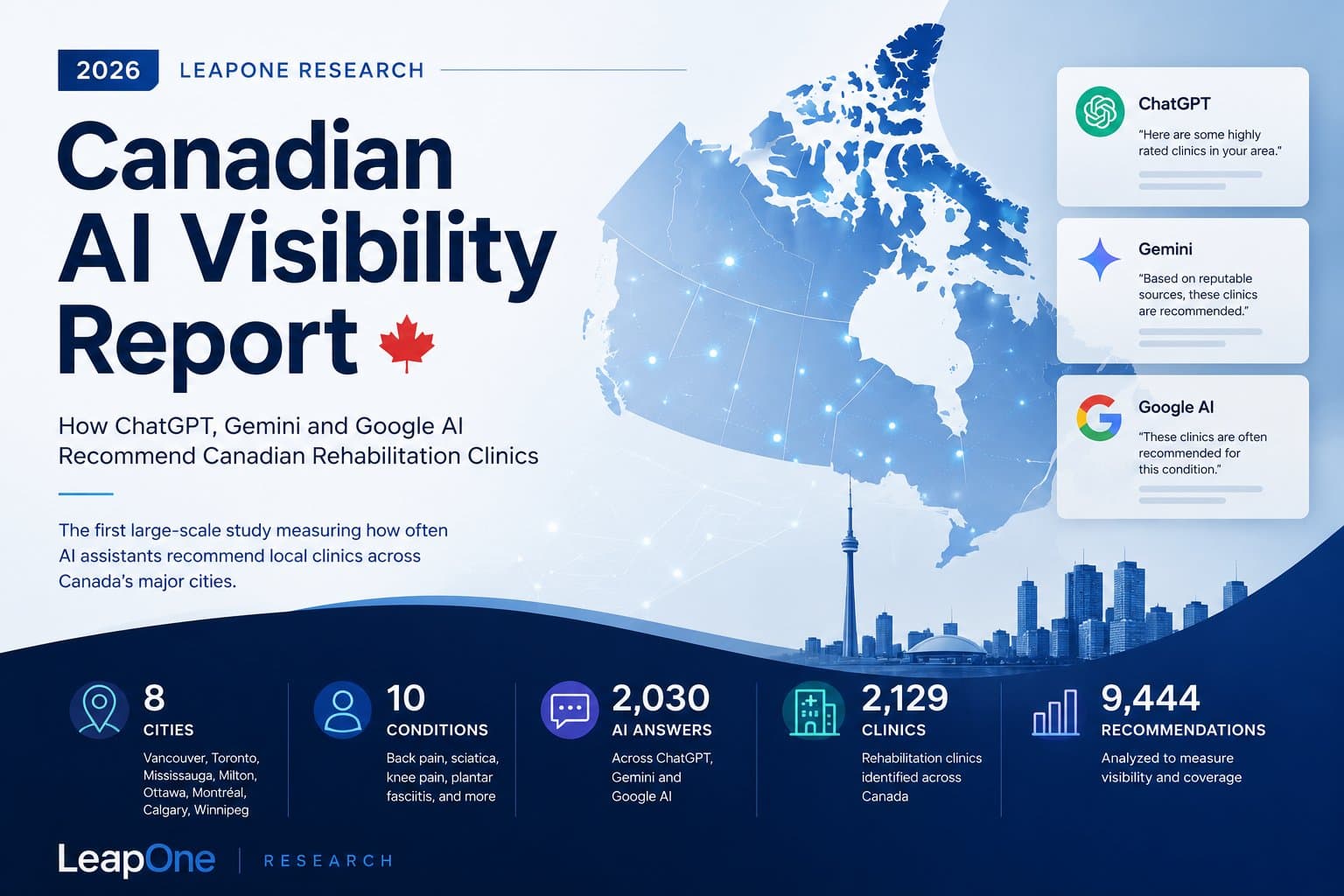
The 2026 Canadian AI Visibility Report — first edition. A LeapOne study of how often ChatGPT, Gemini and Google's AI surface Canadian rehabilitation clinics, across 8 cities and 10 common conditions.
Key finding
Only 31% of Canadian rehabilitation clinics ever appeared in an AI answer. The other 69% were never mentioned once.
663 of 2,129 clinics · 2,030 AI answers · ChatGPT, Gemini & Google AI Overview · June 2026
Canadian AI Visibility Report 2026 · LeapOne Research · leapone.ca
Key findings (Canada, June 2026)
- Canadians now run an estimated ~47,000 AI searches a month for these 10 conditions — up ~73% in a year.
- When someone names their city, the AI chatbots surface a specific clinic 92–99% of the time. Leave the city out and ChatGPT almost never does (13%).
- AI filled thousands of recommendation slots — and drew them all from a small, sticky pool: only ~1 in 3 of a city's rehabilitation clinics ever appeared. Two in three never came up once.
- A handful of clinics soak up the visibility — the top 3 in a city capture ~16–23% of all AI appearances, in fields of ~140–300 clinics.
- The engines disagree. Gemini surfaces a clinic almost always; Google's AI Overview stays generic more than a third of the time.
The search your patients use now doesn't have a page two
Imagine running one of the best physiotherapy clinics in your city — and discovering that AI never recommends you. Not ranked low. Never named, in two thousand answers. For two in three Canadian rehabilitation clinics, that's not a hypothetical: it's what our data shows.
More and more Canadians don't scroll Google to find care. They ask an assistant: "I've had sciatica for three weeks — who should I see in Ottawa?" — and they trust the short list it gives back.
That list is short. Unlike a page of Google results you can climb, an AI answer names three to eight businesses and stops. Nobody expects AI to recite every clinic in town — the real question is whether it keeps drawing from a wide, rotating set, or keeps handing patients the same few names.
We wanted to know, with real numbers, which Canadian clinics AI actually surfaces — and how many it never surfaces at all. So we ran the test 2,030 times.
This research grew out of building LeapOne, a platform that measures how often Canadian businesses appear across the major AI assistants. We kept seeing individual businesses shocked by their own results — and realized nobody had measured how large the gap actually is. So we measured it. To our knowledge, this is the first large-scale Canadian study of how often the major AI assistants recommend local healthcare businesses.
The demand is real, and it's climbing fast
Using DataForSEO's AI-search-volume data, we looked at how often Canadians ask AI assistants about the ten conditions rehabilitation clinics treat most — back pain, sciatica, knee pain, plantar fasciitis, and so on.
The total: roughly 47,000 AI searches a month in Canada, up about 73% from a year earlier. Some conditions are exploding:
| Condition | Growth in AI searches (12 months) |
|---|---|
| Sciatica | +300% |
| Plantar fasciitis | +265% |
| Knee pain | +105% |
| Hip pain | +96% |
Year-over-year growth in AI searches, by condition
DataForSEO AI-search-volume, Canada, June 2025 → June 2026. Modelled estimate — direction, not a precise count.
Canadian AI Visibility Report 2026 · LeapOne Research · leapone.ca
(This is a modelled estimate of AI-assistant demand, not raw chat logs — month to month is noisy, but the yearly direction is unmistakable.)
This is a channel that barely existed two years ago. It's now a river of patients deciding who to call — based on what AI tells them.
The gap: AI draws from a small, sticky pool
Here's the finding. For each city, we built the full list of rehabilitation clinics Google Maps shows — physiotherapy, chiropractic, sports-medicine, pain and rehab clinics. Then we counted how many of them AI ever surfaced — named in an answer or shown as a cited source — across every question, every engine, every phrasing, every repeat.
Take Milton, Ontario: its 210 answers held 1,120 recommendation slots — enough to surface every one of its 144 clinics nearly eight times over. AI used 48 names. And the pool is sticky: the first pass over Milton's questions (70 answers) had already surfaced 45 of those 48 clinics; the remaining 140 answers added just 3 new names. Asking twice as many questions wouldn't change the picture.
AI's pool stabilizes fast
In Milton, the first third of the answers had already surfaced 94% of every clinic AI would ever name (45 of 48). Tripling the questions added just three more names.
If you're not in the pool, more questions won't surface you — something about your presence has to change first.
Canadian AI Visibility Report 2026 · LeapOne Research · leapone.ca
Share of a city's clinics that EVER appeared in any AI answer
The unfilled part of each bar = clinics that never appeared, in any answer, on any engine. The biggest cities are the least visible.
Canadian AI Visibility Report 2026 · LeapOne Research · leapone.ca
Across all eight cities: AI produced 9,444 recommendations — and drew every one of them from just 663 unique clinics, out of 2,129. Picture inviting every rehabilitation clinic in these cities into one room: AI knows the names of one in three. The other two-thirds were invisible — not ranked low, never mentioned or cited at all. And the pattern is worst in the biggest cities, where the most clinics compete for the same few slots.
Being invisible in AI isn't ranking lower. It's disappearing completely.
Location is the on/off switch
The single biggest lever isn't your website or your reviews — it's whether the question has a city in it.
Share of answers that name a specific clinic
Each bar is a separate set of questions, measured on its own — the two bars per engine are not parts of one whole.
ChatGPT
Gemini
Google's AI Overview names a clinic ~64% of the time overall — the most cautious of the three surfaces.
Canadian AI Visibility Report 2026 · LeapOne Research · leapone.ca
The moment a patient says "in Calgary," AI flips from generic advice to naming specific businesses. That's the exact moment you're either in the answer or you're not.
Gemini's 50% is worth a second look: even with no city in the question, half its "how do I fix this" answers cited clinic websites as sources — almost always a clinic's educational blog post or condition page. Useful content earns AI visibility even outside local questions.
A few clinics own the answers
AI recommendation is winner-take-most. In each city, the top three clinics captured roughly 16–23% of every appearance — in fields of ~140–300 clinics, where an even share would be a fraction of a percent each. Once a clinic becomes part of AI's pool for a condition, it keeps getting picked. The long tail gets nothing.
The upside: these leaders aren't always the biggest brands. They're the clinics AI can read clearly — with a strong, consistent web presence AI can ground its answer on.
AI doesn't recommend the best clinic. It recommends the clinics it can read.
The engines don't agree — so you can't optimize for just one
- Gemini almost always surfaces a specific clinic (99% with a city). It behaves the most like a recommendation engine.
- ChatGPT names clinics ~87% of the time, leaning on live web results and citations.
- Google's AI Overview is the most cautious — it stays generic about a third of the time, and for some questions no AI Overview appears at all.
A clinic that looks great in ChatGPT can be invisible in Gemini. Visibility is engine-specific, and there's no single lever that fixes all three.
One more surprise: your competition is wider than you think
Only about a quarter to two-thirds of the businesses AI surfaced were physiotherapy or chiropractic clinics. AI also routed patients to pain clinics, sports-medicine practices, rehabilitation centres — and, for plantar fasciitis, foot and orthotic clinics. The set of businesses competing for "who treats my back pain" in an AI answer is broader than the physio-vs-chiro rivalry most owners picture.
What a clinic owner can actually do
The reassuring part: this is a new, under-contested channel. Most clinics aren't optimizing for AI at all — which is exactly why two in three are invisible, and why the ones who act now can own their condition-and-city answers before the field wakes up.
Concretely:
- Be findable for "condition + city." That's the query that turns AI into a recommender. Make sure your site clearly states the conditions you treat and the neighbourhoods you serve.
- Publish content AI can cite. Plain-language condition pages and blog posts earn citations — Gemini cited clinic content in half the answers that didn't even mention a city.
- Check every engine. Being in ChatGPT's pool tells you nothing about Gemini or Google's AI. Measure all three.
- Watch the wider set. Your AI competitors include pain and sports-med clinics, not just other physios.
This is the problem LeapOne was built to solve — measuring where AI does and doesn't recommend a Canadian business across the major engines, and turning that into the specific moves that close the gap. If you're weighing up software for this, we've also published an honest comparison of the AI search optimization tools — competitors included, and the places they're stronger than us. But whether you use a tool or not, the takeaway is the same:
For twenty years, businesses fought to rank on Google's first page. Now they're competing to be one of the three names AI says out loud — and two in three clinics aren't in that conversation at all.
Methodology
How the study was built
Canadian AI Visibility Report 2026 · LeapOne Research · leapone.ca
- What we measured: how often three AI surfaces recommend a specific local rehabilitation clinic, by condition and city. A clinic counts as appearing if it was named in the answer text or shown as a cited source (source links are visible, clickable parts of the answer in all three engines).
- Engines: ChatGPT (OpenAI GPT-4o with web search, via API), Gemini (Gemini 3.5 Flash with Google Search grounding, via API), and Google AI Overview (via DataForSEO). Consumer-app answers vary by user, location and session — no measurement can reproduce one person's exact answer, so like all AI-visibility measurement, we probe via API and measure the stable pool AI draws from, not any single answer. (Our spot-checks of consumer-app answers landed entirely inside the pool the study mapped.)
- Sample: 8 cities forming 9 city-language markets (Toronto, Mississauga, Ottawa, Milton ON; Montréal QC in English and French; Vancouver, Calgary, Winnipeg), 10 conditions, 4 question styles (3 city-anchored + 1 with no city), 3 engines. The chatbots answered every question 3 times to capture run-to-run variation; AI Overview was fetched once per query. That works out to 870 ChatGPT + 870 Gemini + 290 AI Overview = 2,030 AI answers, holding 9,444 clinic appearances.
- The clinic list (denominator): 2,478 rehabilitation clinics from Google Maps (physiotherapy, chiropractic, pain, sports-medicine and rehab searches, deduplicated); 2,129 with an identifiable website or distinctive name form the denominator. Not a perfect census, but the realistic set a searcher would find.
- Matching: exact-only — a clinic is credited when its website domain appears in an answer's citations, or a citation title exactly equals its name or domain, or its distinctive multi-word name appears verbatim in the text. No similarity scoring; ambiguous names credit no one; every match is auditable.
- Demand: DataForSEO AI-search-volume for Canada — a modelled estimate of AI-assistant demand, reported as a direction, not a precise count.
- Honest limits: our counts are conservative — a clinic AI referenced without a matchable name or domain isn't credited, so real visibility is at least what we report and real invisibility at most. AI answers vary run to run (hence the repeats). Perplexity and Claude weren't included in this round. The study covers one sector (rehabilitation clinics) in 8 cities — the size of the visibility gap may differ in other local categories, and that's exactly what future editions will test. This is a baseline — we'll re-run it quarterly to track the trend.
FAQ
How often does AI recommend a specific clinic?
When the question includes a city, 92–99% of the time for the chatbots; without a city, ChatGPT almost never does (13%). Google's AI Overview surfaces a clinic about 64% of the time overall.
What share of clinics does AI actually surface?
Across all our questions, only about 1 in 3 of a city's rehabilitation clinics ever appeared in any answer — from 24% in Vancouver to 38% in Mississauga. Two in three never appeared at all.
Which AI assistant recommends clinics most?
Gemini surfaced a specific clinic most often (~99% with a city), then ChatGPT (~92%), then Google's AI Overview (~64%).
Is AI search really growing for health questions in Canada?
Yes — AI-search volume for these ten conditions rose about 73% year over year, to an estimated ~47,000 queries a month.
This is the first edition of the Canadian AI Visibility Report by LeapOne. Methodology and aggregate data are available on request; we re-run the same measurement each quarter to track the trend.
About the author
Marwa Saleh
Marwa Saleh is the founder of LeapOne. After a Master’s thesis on decision support systems and two decades building enterprise systems across airlines, real estate, healthcare and telecom, she built LeapOne to help Canadian businesses make sense of AI search. Built in Milton, Ontario.