Google's AI Reads Your Map Listing. ChatGPT Reads the Rankings.
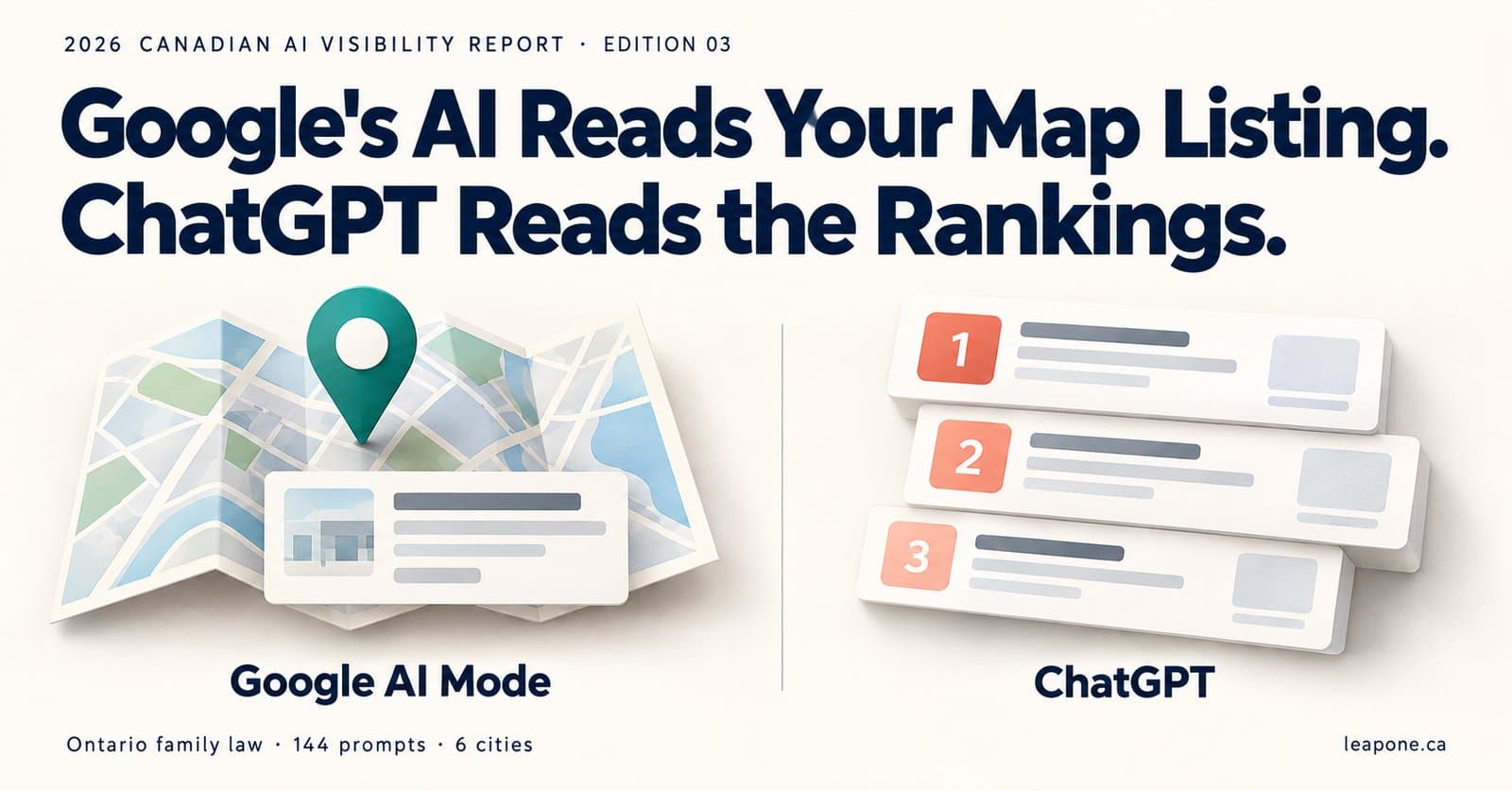
The 2026 Canadian AI Visibility Report — third edition. A LeapOne study of how ChatGPT and Google's AI Mode recommend family lawyers to people in six GTA cities, across four kinds of client question, each asked three times. The first edition measured rehabilitation clinics; the second measured optometry clinics.
Key finding
The two AI tools people ask for a lawyer don't read the same things. Google's AI picks from Google Maps. ChatGPT picks from ranking and review pages.
Google AI Mode
of the sources it used were Google Maps business listings (742 of 808)
ChatGPT
of the firms it named were on a ranking or review page it had just read (234 of 288)
144 AI answers · 6 GTA cities · 4 client questions, each asked three times · October 2026
Canadian AI Visibility Report 2026 · LeapOne Research · leapone.ca
Key findings (Toronto and the GTA, October 2026)
- Two tools, two different sources. Google's AI Mode chose mostly from Google Maps listings. ChatGPT chose mostly from lawyer rankings and review sites — a firm's own website alone accounted for only 8% of the firms it named.
- There are two ways in: reputation or reviews. Established downtown firms got named through peer rankings, often with few Google reviews and middling stars. Almost everyone else got in through a strong Google profile.
- Review count tracked with being named. Star rating didn't. Firms with 300+ Google reviews were named by Google's AI 56% of the time; firms with fewer than 20, 6%. One of the firms both tools named most often had a 2.8-star rating.
- Say "Ontario" and the answer moves downtown. For people outside Toronto, a question about "the best family lawyer in Ontario" was answered with Toronto firms 97% of the time on ChatGPT and 76% on Google's AI.
- Ask ChatGPT for help with a custody case and it named no lawyer at all — in all 18 answers. It sent people to the Law Society's referral service and Legal Aid instead.
Why family law, and why the GTA
Before this study we measured how much people ask about seven areas of law — family, criminal, wills and estates, immigration, personal injury, employment and real estate. Family law had the most demand of the seven, both on AI tools across Canada and on Google in Ontario.
We also measured how people phrase the question. That turned out to matter more than we expected.
| How the question is phrased | Google (Ontario) | AI tools (Canada) |
|---|---|---|
| Names no place — "best family lawyer" | 29% | 73% |
| Names a city — "family lawyer Mississauga" | 49% | 10% |
| "near me" | 16% | 0% |
| Names the province — "…in Ontario" | 5% | 16% |
| Names a region — "…in the GTA" | 2% | 0% |
Share of measured family-lawyer search volume, by phrasing. The AI figures are modelled estimates, not usage logs, and are only available Canada-wide. Read them as direction, not as a count.
On Google, people type their city. On AI, they mostly don't — and when they do name a place, it's more often "Ontario" than a city. A family lawyer licensed in Ontario can act anywhere in the province and can meet clients online, so a client in Brampton may well hire a firm in Toronto. That's why we didn't just ask about each city: we placed a simulated client in each city and asked the way people actually ask.
Finding 1 — Google's AI picks from Google Maps
Of the 808 sources Google's AI Mode used across its 72 answers, 742 were Google Maps business listings — the same profile cards you see in a map search, with a star rating and review count. For more than half of the firms it named (177 of 309), the source was the firm's own Google listing.
Those cards also showed us something rare: the firms it was given but chose to leave out. Across the 42 answers that included listings, it was shown 742 and named 198 of them.
| Among the listings it was shown | Named | Left out |
|---|---|---|
| Median Google Maps position in the client's city | 9 | 22 |
| Median Google reviews | 186 | 138 |
| Median star rating | 4.9 | 4.9 |
The firms it named sat higher on the map in the client's own city and had more reviews. Their star rating was identical.
What this means for you. For Google's AI, your Google Business Profile isn't a side task — it's the shortlist. Your position on the map in your own city and the number of reviews behind you are what separated the named from the passed-over.
Finding 2 — ChatGPT picks from rankings and review sites
ChatGPT works differently. It searches the web and reads pages before it answers, and we read the same pages it cited. For 234 of the 288 firms it named, the firm's name appeared on a third-party page ChatGPT had just read. For only 24 was the firm's own website the sole page that named it.
The pages it leaned on most were peer rankings and review sites: Lexpert, Best Lawyers and Best Law Firms, Doyle's Guide, Birdeye review pages and TrustAnalytica. We're not affiliated with any of them, and this isn't advice to buy a listing — it's simply where ChatGPT's recommendations came from. Its single most-cited site was the Law Society of Ontario's own lawyer directory, in 46 of its 72 answers.
What this means for you. A great website on its own rarely got a firm named by ChatGPT. Being on the independent pages it reads did.
Finding 3 — Two ways in: reputation or reviews
When we split the firms each tool named by how they got there, two very different groups appeared.
| Named via a peer ranking | Every other named firm | |
|---|---|---|
| ChatGPT — firms | 26 | 51 |
| Office in Toronto | 21 of 26 | 11 of 51 |
| Median Google reviews | 23 | 61 |
| Median star rating | 4.3 | 4.7 |
| Google AI Mode — firms | 21 | 58 |
| Office in Toronto | 14 of 21 | 17 of 58 |
| Median Google reviews | 18 | 101 |
| Median star rating | 4.2 | 4.8 |
"Named via a peer ranking" = the firm appeared, at least once, on a ranking page (Lexpert, Best Lawyers, Best Law Firms, Doyle's Guide, Chambers, Canadian Lawyer) that the tool cited in the same answer.
The first group is the established, mostly downtown firms that the legal rankings already know. They got named with modest Google profiles. The second group — most of them outside Toronto — had no ranking to lean on, and got named with several times as many reviews: a median of 61 against 23 on ChatGPT, and 101 against 18 on Google's AI.
What this means for you. If your firm isn't on the peer rankings, your Google profile is your way in. If it is on them, you're already being read — but by ChatGPT more than by Google's AI.
Finding 4 — Review count tracked with being named. Star rating didn't.
We took every law practice in the six cities' top 100 Google Maps results for "family lawyer" — 452 in total — and checked which ones each tool named.
| Google reviews | Named by ChatGPT | Named by Google's AI |
|---|---|---|
| 0–19 | 8% (13 of 167) | 6% (10 of 167) |
| 20–99 | 14% (29 of 200) | 11% (22 of 200) |
| 100–299 | 17% (12 of 69) | 30% (21 of 69) |
| 300+ | 44% (7 of 16) | 56% (9 of 16) |
The same pattern showed up for position. Firms in a top-three map spot in one of the six cities were named 73% of the time by both tools (8 of 11); firms ranked below 30th, 4–6%. Firms on the first page of Google's ordinary search results were named five to six times as often as firms that weren't.
Star rating showed no difference: the median for named firms was 4.6 (ChatGPT) and 4.8 (Google's AI), against 4.8 for the rest. That matches what we found in optometry. It also doesn't contradict that study's finding that most AI picks weren't in the map's top three: here too, only 8 of the 61 practices ChatGPT named from this list held a top-three spot. There are only a handful of those spots — and the firms that hold one usually get named.
What this means for you. Ask every client you've helped for a review, steadily. Volume moved with being named; the decimal point didn't.
Finding 5 — Where the client is matters — until they say "Ontario"
Both tools take a rough guess at where you are, the way your phone or browser does. We placed a simulated client in each city and checked where each recommended firm actually has its office. These figures cover clients outside Toronto, where the question is whether they're kept local or sent downtown.
| The client asks… | ChatGPT: local firm | ChatGPT: Toronto firm | Google's AI: local firm | Google's AI: Toronto firm |
|---|---|---|---|---|
| "…in [my city]" | 86% | 8% | 93% | 6% |
| No place at all | 66% | 24% | 38% | 59% |
| "…in Ontario" | 1% | 97% | 13% | 76% |
Clients in Mississauga, Brampton, Vaughan, Markham and Oakville. Share of named firms whose office we could locate. The remainder were elsewhere in the GTA or beyond.
Two things stand out. When the client names nothing — which is how most AI questions are asked — ChatGPT mostly kept them local, while Google's AI sent most of them to Toronto. And "in Ontario" sent nearly everyone downtown, on both tools.
What this means for you. If you practise outside Toronto, your strongest ground is your own city. A question that names the province goes to downtown firms almost every time.
Finding 6 — Ask ChatGPT about a custody case and it won't name a lawyer
One of our four questions described a need rather than asking for "the best": "I need a lawyer for a child custody case. Who do you recommend?"
ChatGPT didn't name a single firm in any of the 18 answers. Every one pointed the person to the Law Society of Ontario's referral service and to Legal Aid Ontario. Google's AI named firms in 14 of its 18.
What this means for you. For a client describing a real problem, ChatGPT's front door is the Law Society's referral service, not a firm. If you take referrals through it, that's where these clients are being sent.
Finding 7 — The two tools barely agree
Across all 144 answers, ChatGPT named 93 different firms and Google's AI named 82. Only 44 were named by both. Asked the same question by the same simulated client, the two tools had a median of 19% of their firms in common.
What this means for you. "Am I visible in AI?" has two answers, and they come from different places. Each tool has to be checked separately.
How we did this
We placed a simulated client in each of six cities — Toronto, Mississauga, Brampton, Vaughan, Markham and Oakville — using the approximate location each tool uses to guess where you are. Each client asked four questions: "Who is the best family lawyer?", "I need a lawyer for a child custody case. Who do you recommend?", "Who is the best family lawyer in Ontario?" and "Who is the best family lawyer in [their city]?" Every question went to ChatGPT (with web search on) and to Google's AI Mode, three times each — 144 answers, all collected on 9 October 2026.
For every firm named, we found its Google Maps listing to get its office location, reviews, rating and map position, and we checked Google's ordinary search results for "family lawyer" in each city. We then read the pages each answer cited — respecting each site's rules for automated visitors — to see which page named which firm. To compare named firms with everyone else, we took the top 100 family-law results on Google Maps in each city: 452 law offices in all. Firms were matched to their listing by name, and checked by hand where the name was ambiguous; 18 of the 181 names the tools used couldn't be matched to a listing and are counted as "office unknown".
What this study does not tell you
- It shows what the named firms had in common. It doesn't prove those things caused the recommendation — a firm with more reviews usually differs in other ways too, and big firms tend to have reviews, rankings and good map positions all at once.
- It covers family law in six GTA cities. Other practice areas and other provinces may behave differently.
- It covers two tools, queried automatically: ChatGPT through OpenAI's official interface, and Google's AI Mode through a search-data provider. The ChatGPT app can also use your chat history, which we didn't simulate.
- Everything here reflects a single day. These systems change.
Where to start
If you take one thing from this: Google's AI and ChatGPT pick from different places, so you need to be in both.
- For Google's AI: your Google Business Profile, your position on the map in your own city, and a steady flow of reviews.
- For ChatGPT: the independent pages it reads — peer rankings and review sites — not just your own website.
- Check them separately. They agree on only about one firm in five.
Run a free AI visibility check on your firm — you'll see which AI tools mention you, and which name a competitor instead.
FAQ
How does ChatGPT decide which family lawyer to recommend?
It searches the web and reads pages before it answers. In our study, 234 of the 288 firms ChatGPT named appeared on a third-party page it had just read — mostly peer rankings such as Lexpert, Best Lawyers and Doyle's Guide, and review sites such as Birdeye and TrustAnalytica. Only 24 were found on the firm's own website alone. This shows where its recommendations came from, not proof of what caused them.
Does Google's AI Mode use Google Maps and reviews to recommend lawyers?
Yes — 742 of the 808 sources Google's AI Mode used were Google Maps business listings. Among the listings it was shown, the firms it named had a median map position of 9 in the client's city against 22 for those it left out, and a median of 186 reviews against 138. Their star ratings were identical, at 4.9.
Do star ratings matter for being recommended by AI?
Not in our data. Named and unnamed firms had essentially the same median rating (4.6–4.8). Review count is what moved: firms with 300 or more Google reviews were named 44% of the time by ChatGPT and 56% by Google's AI, against 6–8% for firms with fewer than 20. One of the firms both tools named most often had a 2.8-star rating.
Will AI recommend a family lawyer outside the client's city?
Often, yes. For clients outside Toronto asking "who is the best family lawyer in Ontario", 97% of ChatGPT's firms and 76% of Google's AI's firms were in Toronto. When the question named no place, ChatGPT kept 66% of its picks local, while Google's AI sent 59% to Toronto. When the client named their city, both kept 86–93% local.
How was this study done?
We placed a simulated client in each of six GTA cities — Toronto, Mississauga, Brampton, Vaughan, Markham and Oakville — and asked four family-law questions, three times each, on ChatGPT (with web search) and Google's AI Mode: 144 answers, collected on 9 October 2026. Every named firm was matched to its Google Maps listing, and every cited page was read to see which page named which firm. Named firms were compared with the top 100 Google Maps family-law results in each city, 452 law offices in total. It shows patterns, not proof of cause, and reflects a single day.
About the author
Marwa Saleh
Marwa Saleh is the founder of LeapOne. After a Master’s thesis on decision support systems and two decades building enterprise systems across airlines, real estate, healthcare and telecom, she built LeapOne to help Canadian businesses make sense of AI search. Built in Milton, Ontario.